What happens when a sixth grader stops reading about climate change in a textbook and starts coding, with their own hands, the sensor that decides when to water the school garden? That's design thinking applied to the climate crisis: a five-phase process — empathize with an affected community, define the environmental problem, ideate a solution, prototype, and test — that turns the most abstract and overwhelming problem a child can face into a concrete, measurable, personal engineering project. Forward Education's Climate Action Kit sets that process in motion in the classroom with a micro:bit and plug-and-play sensors and motors: the prototype stops being a cardboard model and becomes a system that actually measures and responds.
The kit packs 73 parts and more than 15 standards-aligned lessons, built so any teacher — with or without a computer science background — can run it without designing the process from scratch. It isn't a generic robotics kit with a "sustainability" sticker slapped on: every lesson is built specifically around climate action, and in California schools it has already produced automated irrigation systems, composting monitors, and environmental data dashboards designed entirely by the students themselves.
What is the Climate Action Kit?
The Climate Action Kit is a STEM tool designed to let teachers run coding and robotics lessons without any prior computer science background. It includes 73 pieces — plug-and-play sensors, motors, and building blocks — and an Edge Connector Breakout Board that transmits code from the micro:bit to the robotic parts of the project. With it, students in grades 3-12 (recommended ages 8-18) build a range of climate action solutions: from automated irrigation systems to composting monitors and programmed environmental-awareness displays.
The kit requires a micro:bit V2 (sold separately) and includes access to Forward Education's Learning Platform, with more than 15 ready-to-use lessons and coding tutorials. It's available as a Single Kit or a 15-unit Class Pack, sized to equip a full classroom.
Every one of the Climate Action Kit's 15+ lessons is aligned to Next Generation Science Standards (NGSS), Common Core State Standards (CCSS), CSTA, US State Standards, and Canadian Provincial/Territorial Standards — the same curricular framework thousands of North American schools already use.
The 5-phase Design Thinking process: from empathy to prototype
The Climate Action Kit doesn't teach coding in isolation — it teaches coding within a five-phase Design Thinking process, the same methodology real-world design and engineering teams use to solve human-centered problems. Applied to climate action, the process looks like this:
This cycle integrates with the Use-Modify-Create teaching framework: students first use existing code, then modify it to fit their problem, and finally create their own solution from scratch. Each student documents their process in a Design Journal — their personal workspace — and uses an Algorithm Planning Worksheet to plan their code's logic before writing it.
The result is genuine development of critical thinking and problem-solving — not memorization of coding syntax. Students build 21st-century skills through a real STEM project, with a real problem behind it.
Product profile: Climate Action Kit
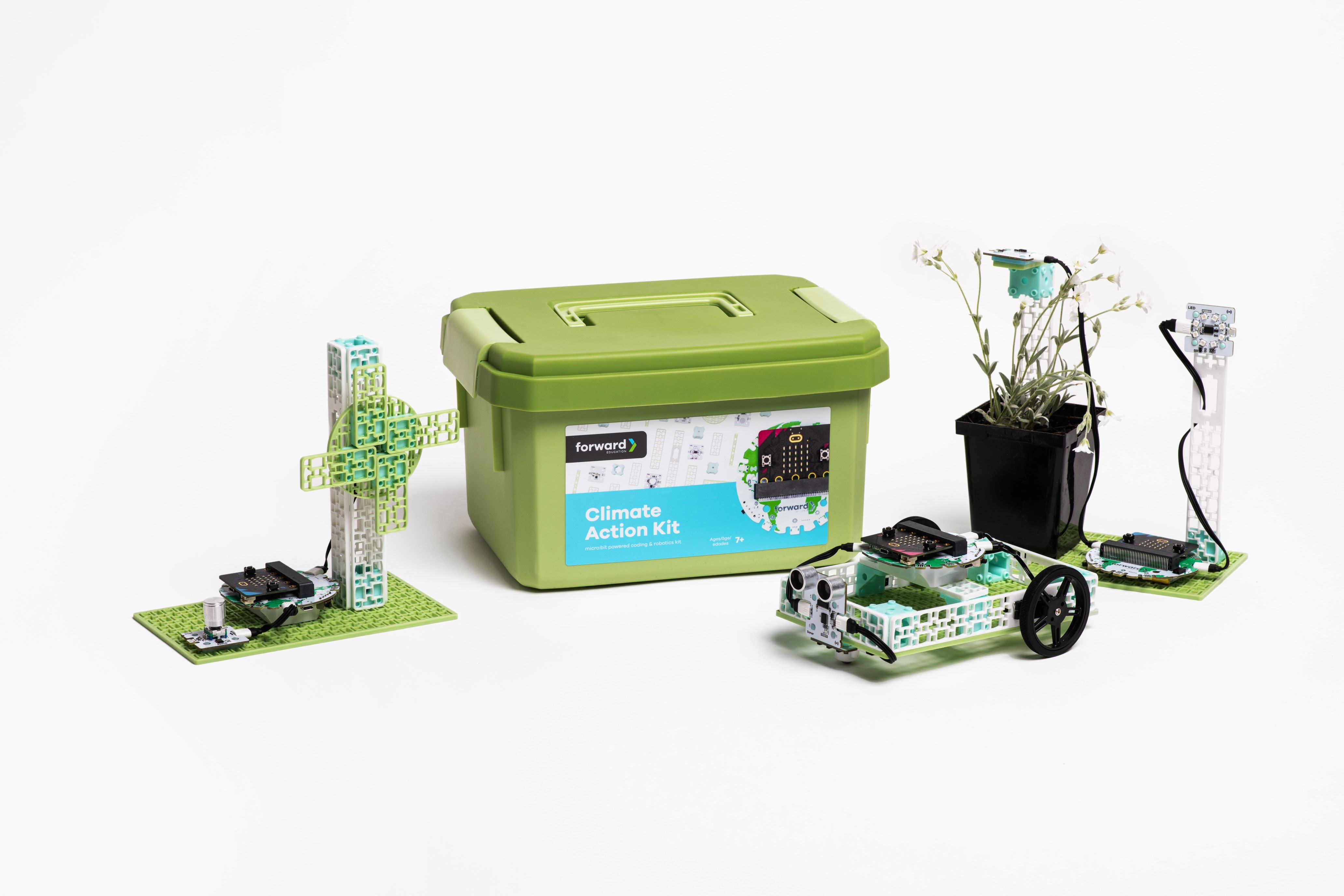
Climate Action Kit
User-friendly STEM teaching tool that lets teachers run coding and robotics lessons without a computer science background. Includes all the hardware needed to build a range of climate action solution projects, with plug-and-play sensors, motors, and building blocks.
Includes: access to Forward Education's Learning Platform · 15+ curriculum-aligned lessons and coding tutorials (NGSS, Common Core, CSTA, State/Provincial Standards) · plug-and-play sensors, motors, and building pieces
The testimonial: what a teacher sees when the kit lands in students' hands
In this video testimonial for Forward Education, educator Kyle Kitchen describes what happens in the classroom when students get their hands on the Climate Action Kit for the first time — the jump in STEM engagement, the emergence of new young women engineers, and how the kit's design lets students at any coding experience level find their entry point:
"When you hand them the Climate Action Kits, all of a sudden more people get interested. The creativity that kicks in — what could we make with this? — you're seeing a lot more people get involved in STEM, and those 'what if' moments happen a lot more when it comes to designing and creating something with their own hands to solve a problem."— Kyle Kitchen, STEM educator, video testimonial for Forward Education
"I'm always going to promote girls in STEM, because we've done a lot of events this year, and there are so many teams of young women engineers who have suddenly just appeared. It's amazing to see, because they're seeing themselves as people who can code, who can design and build."— Kyle Kitchen, STEM educator, video testimonial for Forward Education
"The amount of scaffolding for kids who are new to coding, and for the experts too — they all had entry points they could work with in the lessons. Some used the step-by-steps once we discovered them, some just built. Teachers are so appreciative that you've provided everything they need to teach a great lesson on climate action — but you've also given the ability to scaffold, whether a student has never coded or has coded lots of different things. We can't hold our students back because we're afraid they might break it; when you put something well thought-out in their hands, that's when you see them shine."— Kyle Kitchen, STEM educator, video testimonial for Forward Education
"I had a teacher yesterday who ran a great big coding event, and he said this was awesome — because some of us veteran teachers need a little kick in the pants to realize we can do this, and our students need us to do it. He's one year away from retirement, and he's learning how to code because his grade fours are learning how to code."— Kyle Kitchen, STEM educator, video testimonial for Forward Education
From Riverside STEM Academy to California's ELOP funds: real cases in the classroom
At Riverside STEM Academy — ranked the #1 public high school in California by U.S. News & World Report — students in the Science Olympiad classroom used the Climate Action Kit to build an irrigation system with soil moisture sensors, coded to water plants automatically only when needed. The project, part of the kit's Data Driven Smart Farming lesson, is a direct example of how smart, sustainable agriculture becomes a tangible coding project for students.
In California, the Expanded Learning Opportunities Program (ELOP) — a state fund for expanded learning programs — is financing the Climate Action Kit as a gateway into computer science through at least three distinct models:
- Computer Science for Good Clubs: afterschool clubs that use the Climate Action Kit for STEM and coding programs centered on renewable energy, water conservation, and smart agriculture — building skills for future careers in sustainability.
- Climate Literacy Champions Program: schools designate "champions" who strengthen climate literacy during out-of-school time. Students program micro:bit sensors to collect environmental data, coordinating the project with school gardens and water reclamation programs.
- San Bernardino County Office of Education initiative: County Office of Education (COE) educators train elementary school teachers and then supply them with Climate Action Kits for hands-on STEM projects in the classroom.
"The Climate Action Kit transforms abstract climate concepts into tangible, interactive learning experiences for students."— Tonya Coates, Digital Learning and Computer Science Project Specialist, San Bernardino County Superintendent of Schools
All three models share something in common: they use the same kit, the same Design Thinking methodology, and the same micro:bit — only the implementation context changes. That flexibility is exactly what allows the program to adapt to the reality of each country and each budget across Latin America.
Districalc and Forward Education: climate action with standards across Latin America
Districalc, a distributor of educational technologies present in over 20 Latin American countries since 1981, offers the Climate Action Kit and the rest of Forward Education's micro:bit kit ecosystem — Smart Solar Energy Kit, Smart Hydroponics Kit, CodeCTRL, and more — to educational institutions across the region. The same curricular framework validated across hundreds of US and Canadian schools — NGSS, Common Core, CSTA — is now available across Latin America.
If your institution wants to bring Design Thinking and climate action into the classroom — as an afterschool club, a science subject, or a robotics project — Districalc can support the whole process: kit supply, teacher training, and pedagogical support to adapt the lessons to your local curriculum.
Is your institution interested in the Climate Action Kit or other Forward Education kits? Contact us — Districalc works with schools, technical high schools, and ministries of education in over 20 Latin American countries.
Ready to bring climate action into your institution's classroom?
Districalc supplies Forward Education's Climate Action Kit, teacher training, and pedagogical support to implement Design Thinking in your STEM curriculum — in any country in Latin America.
Contact UsFrequently asked questions
What grade levels is the Climate Action Kit appropriate for?
The Climate Action Kit is designed for students in grades 3-12, with recommended ages 8-18 years old. The lessons are structured so students at any programming experience level find an entry point, from beginners to advanced students.
How many class hours does a complete Climate Action Kit project require?
The kit includes over 15 curriculum-aligned lessons and tutorials ready to use. Each lesson can be adapted to available class time, from a short session to an extended multi-week project as an afterschool club or full subject course.
What additional equipment do I need besides the Climate Action Kit?
The kit requires a micro:bit V2, sold separately. The Individual Kit includes 73 plug-and-play pieces, or the 15-unit Class Pack can outfit an entire classroom. Access to Forward Education's learning platform is included with both formats.
What are examples of real projects students have built with this kit?
Students have built automated irrigation systems with soil moisture sensors, composting monitors, environmental data dashboards, and programmed environmental awareness displays. At Riverside STEM Academy (California), the Data Driven Smart Farming project implemented smart agriculture with sensors programmed for automatic watering only when needed.
Are the kit's lessons aligned to international curriculum standards?
Yes, all lessons are aligned to Next Generation Science Standards (NGSS), Common Core State Standards (CCSS), CSTA, US State Standards, and Canadian Provincial/Territorial Standards. The same curriculum framework is validated in hundreds of North American schools and now available across Latin America.