Biomechanics can be taught in the classroom through two complementary paths: as human movement kinematics — using the students themselves as research subjects in classroom experiments on jumps, joint angles and movement patterns — or as musculoskeletal tissue material testing with Vernier's Go Direct® Materials Test Frame (GDX-MTF), characterizing the strength, nonlinearity and viscoelasticity of bone, tendon and intervertebral disc. The first path only needs a ruler and a goniometer to get started, and scales up to 2D/3D motion tracking and Vernier® force plates. The second is an open-ended, university-level lab where students explore how degeneration or injury change a tissue's mechanical behavior — using replicas the university itself can 3D print or request from Districalc.
What does a high school student measuring the height of their own vertical jump have in common with a biomedical engineering student characterizing the stiffness of an intervertebral disc replica? Both are doing biomechanics — the study of the forces and materials that make human movement possible. The second can do it with a lab instrument designed specifically for that: Vernier's Go Direct® Materials Test Frame (GDX-MTF).
Biomechanics rarely has a fixed home in the Latin American curriculum: too applied for pure physics, too organic for classic civil engineering, and too quantitative to stay only in physical education. That ambiguity is actually its strength — it lets you build a classroom project that connects physics, engineering and health sciences around a question every student immediately understands: why does the body move, and how much can its tissues take?
Two paths into biomechanics in the STEM curriculum
Educational biomechanics naturally splits into two lines of work, and both fit inside the infrastructure a well-equipped physics or civil engineering lab already has. The first is human movement kinematics: observing, measuring and modeling how the body moves. The second is biological materials testing: measuring how musculoskeletal tissues respond when load is applied.
Both lines share something important: they turn the student — their own body, or a replica of a body tissue — into the object of study. That closeness is what consistently makes biomechanics one of the most memorable classroom projects a teacher can introduce.
Human movement kinematics: the student as research subject
The first path is inquiry-based research into human movement patterns, run in class with the students themselves as subjects. A particularly effective case study — used in leading US biomedical engineering programs — is measuring vertical jump height as a function of knee flexion angle: students jump with different degrees of initial knee flexion, measure the height reached, and look for the relationship between joint geometry and jump performance.
That case study is just a starting point. The same format lets you give students an open instructional framing to pose their own movement research questions: how does stride change running uphill? what launch angle maximizes a pass's range? how does reaction time vary with fatigue? The inquiry structure stays the same in every case — only the question changes.
What makes this module especially flexible is that the required resources scale with course complexity, not the other way around:
- Basic tier — ruler and goniometer: with a measuring tape for jump height and a goniometer for knee flexion angle, a high school course can run the complete study with no specialized equipment at all. It's the ideal entry point for introducing the scientific method with data students generate themselves.
- Intermediate tier — 2D/3D motion tracking: free, open-source motion tracking platforms, run on students' own phones or computers, capture the full jump trajectory — not just peak height — and compute joint velocity and acceleration frame by frame.
- Advanced tier — Vernier® force plates and sensors: for university biomechanics or biomedical engineering courses, adding a Go Direct® force plate and acceleration sensors measures ground reaction force during the jump, not just its kinematic outcome — and lets students compare the force calculated from kinematics with the force measured directly.
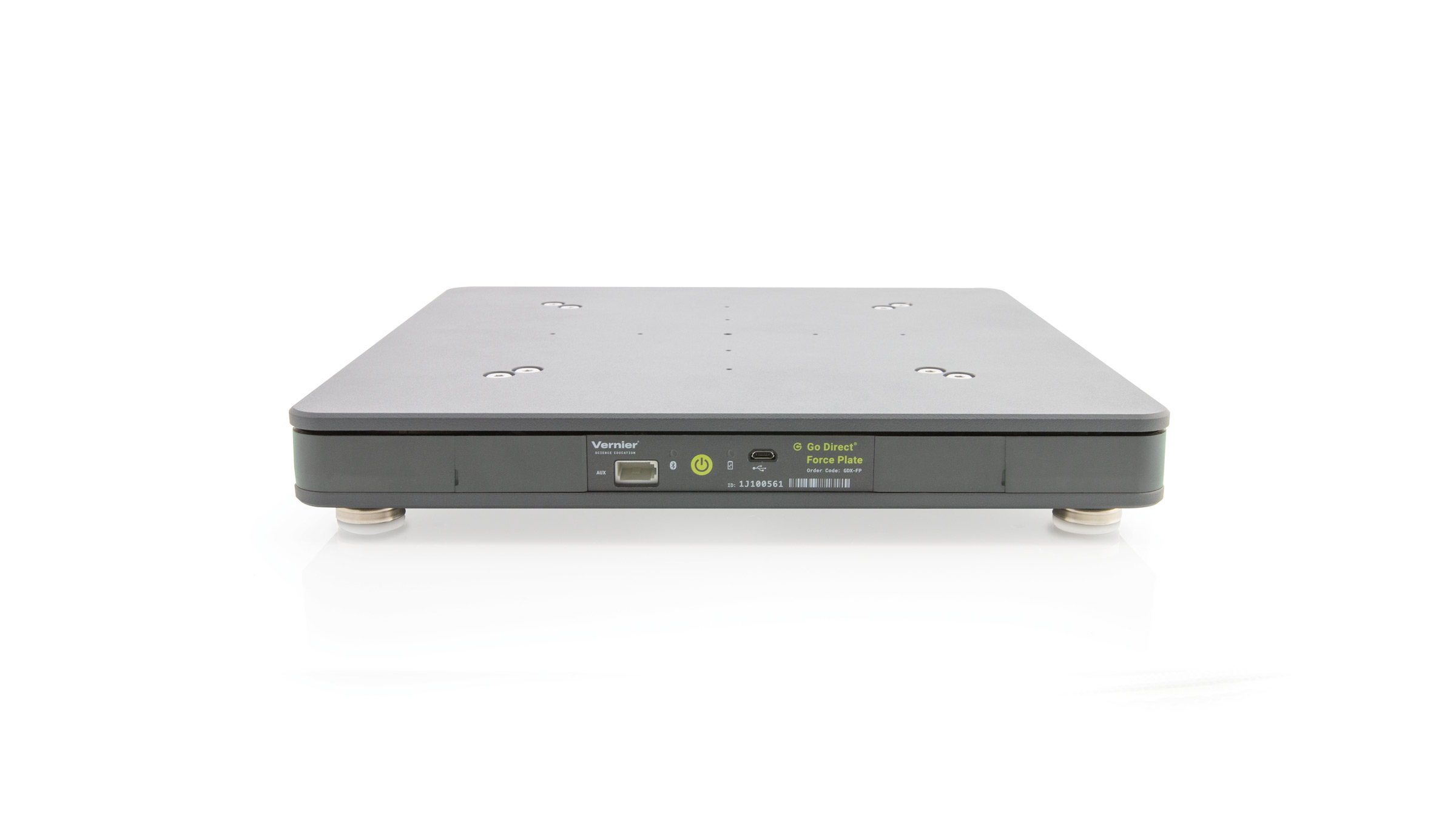
The Go Direct® Force Plate (GDX-FP) measures ground reaction force during the jump — the advanced tier of the human movement module. Photo: Vernier Science Education
As with any activity that uses students as research subjects, it is good practice to follow the institution's ethical and safety guidelines: informed consent in university courses, a proper warm-up before jumping, and a safe landing surface. The vertical jump is a standard, low-risk kinesiology test, but it deserves the same care as any supervised physical activity.
Musculoskeletal tissue material testing: bone, tendon and intervertebral disc
The second path leaves kinematics behind and moves into the materials testing lab, with Vernier's Go Direct® Materials Test Frame (GDX-MTF). Here the goal is to characterize the mechanical behavior of musculoskeletal tissues — bone, tendon and intervertebral disc — and explore how degeneration or injury change that behavior. It is appropriate content for undergraduate and graduate courses in mechanical, biomedical and materials engineering, and it fits naturally into a civil engineering or materials science lab already equipped for load and deflection testing.
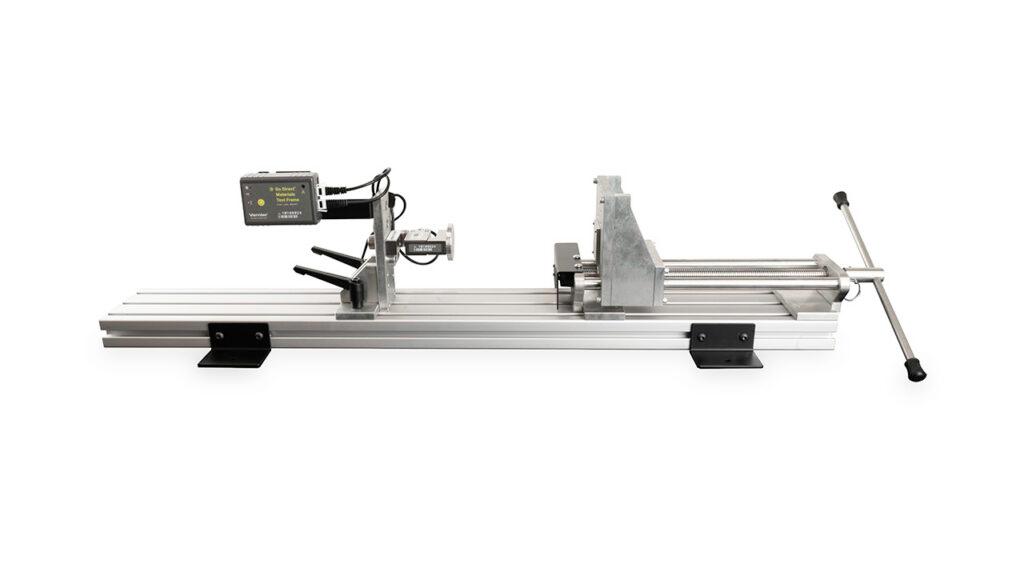
The Go Direct® Materials Test Frame (GDX-MTF) measures force and displacement in tension and compression tests — developed with the University of Delaware Mechanical Engineering Department for its E3 Biomechanics curriculum. Photo: Vernier Science Education
These are open-ended labs by design: there is no single correct answer, but a set of material parameters each student team calculates from its own test data — stiffness, elastic modulus, yield point — plus concepts rarely taught with real data at the undergraduate level:
- Nonlinearity: unlike steel or aluminum, biological tissue almost never has a linear force-displacement relationship. The curve the GDX-MTF records in real time makes that nonlinearity visible from the very first test, instead of leaving it as a theoretical simplification.
- Viscoelasticity: tendons and intervertebral discs respond differently depending on loading rate — stiffer under fast loading, softer under slow loading. Repeating the same test at different rates turns that abstract concept into a measured data point.
- Effect of degeneration and injury: comparing healthy tissue replicas with replicas that simulate degeneration (for example, reduced bone density or a dehydrated intervertebral disc) lets students quantify how strength and stiffness change — a central question in clinical and orthopedic biomechanics.
- Experimental design and statistics: with enough replicas for repetition and degeneration variables as a treatment, the lab lends itself naturally to introducing experimental design, sample size and statistical analysis — not just materials mechanics.
For bone, tendon or intervertebral disc replicas, there is no need to depend on a single biomedical model supplier: many universities in the region already have 3D printers and print their own anatomical replicas from open-source models, adjusting geometry and infill density to approximate different stiffness levels or simulate degeneration. If your institution does not have that capability yet, Districalc can advise on test geometries compatible with the GDX-MTF and help source the models you need.
Product profile: Go Direct® Materials Test Frame (GDX-MTF)
The Go Direct® Materials Test Frame is Vernier's instrument designed specifically for materials testing in biomechanics, mechanical engineering and materials science. It was developed in collaboration with the University of Delaware's Mechanical Engineering Department for its E3 Biomechanics curriculum, and includes interchangeable tension grips and compression platens — a different instrument from the Go Direct® Structures & Materials Tester (GDX-VSMT) that Districalc recommends for civil engineering and bridge competitions.
Go Direct® Materials Test Frame
A tabletop materials testing system, designed so students run the test themselves — not just watch it. A ±4,000 N load cell and a displacement encoder let students measure maximum load and generate force-displacement curves, analyzed with Vernier Graphical Analysis® software.
Includes: test frame with force and displacement sensors, handle with post connector, 4 stabilizing feet, electronics box with mounting brackets, USB-C to USB-A cable, compression platens, tension grips, hex wrenches and a calibration spring.
Where it fits in your curriculum: Physics and Civil Engineering
If your course leans toward kinematics — motion, force, acceleration — the human movement module fits naturally into the Physics lab, alongside the Go Direct® motion and force sensors you are probably already using for mechanics and dynamics.
If your course leans toward materials strength — stiffness, elastic modulus, failure behavior — the GDX-MTF tissue testing module fits alongside the Civil Engineering catalog, where Districalc already distributes Vernier's Go Direct® Structures & Materials Tester (GDX-VSMT) to test structures and run bridge competitions.
Many university programs in biomedical, mechanical or materials engineering combine both modules into a single biomechanics course — and it is exactly that cross-departmental character that makes the GDX-MTF an investment that pays off across several departments at once, not just one.
Districalc can help you set up a biomechanics module
Districalc, a distributor of educational technologies present in over 20 Latin American countries since 1981, is Vernier's regional partner for physics as well as civil and materials engineering. If your institution — a technical school, engineering faculty or health sciences program — wants to add biomechanics to its curriculum, we can help you decide which path (movement or materials) best fits your course and budget.
We can help you bring in the GDX-MTF for the materials module, the Go Direct® motion and force sensors for the kinematic module, and we offer in-person and remote teacher training for both paths. Contact us to talk about your program.
Ready to bring biomechanics into your curriculum?
Districalc supports you with the GDX-MTF, Go Direct® motion sensors and teacher training so your biomechanics module — kinematic or materials-based — has real data from day one.
Contact UsFrequently asked questions
Does human movement biomechanics require Vernier® force plates to get started?
No. The vertical jump and knee flexion angle case study can be run with a measuring tape and a goniometer, with no sensors at all. Go Direct® force plates and 2D/3D motion tracking are optional tiers added when the course has more budget or wants more precision — they are not an entry requirement.
What student level can do the musculoskeletal tissue testing module?
It is appropriate content for undergraduate and graduate courses in mechanical, biomedical and materials engineering. It requires prior understanding of concepts like stress, strain and elastic modulus, so it fits better in university courses than in high school — unlike the human movement module, which works well from high school onward.
Where do bone, tendon or intervertebral disc replicas for the GDX-MTF come from?
Many universities in the region already have 3D printers and print their own replicas from open-source models, adjusting geometry and density to approximate different stiffness levels. If your institution does not have that capability, Districalc can advise on test geometries compatible with the GDX-MTF and help you source the models you need.
What is the difference between the GDX-MTF and the GDX-VSMT?
They are two distinct, complementary Vernier instruments. The Go Direct® Structures & Materials Tester (GDX-VSMT), which Districalc recommends for civil engineering, is optimized for beams, trusses and bridge competitions, with a force range up to 1,000 N. The Go Direct® Materials Test Frame (GDX-MTF) is a different instrument, developed with the University of Delaware specifically for biomechanics and materials engineering, with interchangeable tension and compression grips and a force range up to ±4,000 N — the right fit for testing bone, tendon and intervertebral disc.
Can the movement module and the materials module be combined in one course?
Yes, and it is common in biomedical or mechanical engineering programs: the kinematic module introduces forces and motion at the scale of the human body, and the materials module goes deeper into how the tissues that make that movement possible respond mechanically. Together they form a complete introductory biomechanics course with real data at both ends.