Gas chromatography separates and identifies compounds in a mixture: the sample enters a heated column, travels with a carrier gas, and each molecule stops at a different point depending on how easily it evaporates or how strongly it sticks to the column. It's a cornerstone technique in chemistry education, but the cost and complexity of a traditional GC setup — high-pressure compressed gas tanks, filtration systems — has kept it out of reach for most undergraduates.
Vernier's Go Direct Mini GC solves that: it runs on room air as the carrier gas, with no tanks or filtration to maintain. Students connect it to a laptop, tablet or Chromebook over Bluetooth or USB, open the free Vernier Instrumental Analysis® app, and do real science — analyzing unknown mixtures, measuring retention times, and identifying compounds against reference standards, just like in a professional lab.
What is the Go Direct Mini GC?
This type of experience normally requires a very expensive device and a dedicated technician. Now it fits on a lab bench and in a department budget. The Go Direct Mini GC is a compact, portable gas chromatograph (108 × 191 × 133 mm, 1.3 kg) built specifically for the classroom: students inject directly into the column using the included 1 µL Hamilton syringe, with no compressed carrier gas and no extra filtration system needed.
It connects wirelessly via Bluetooth or by USB cable to any laptop, tablet, or Chromebook, and runs on the free Vernier Instrumental Analysis® app. It's also compatible with LabQuest 2 and LabQuest 3. The result is that an entire organic or analytical chemistry course can have direct access to an instrument — not a simulation, not a teacher demo — at every lab bench.
For organic chemistry courses already using Organic Chemistry with Vernier (26 experiments covering GC, spectrometry, polarimetry, and more), the Mini GC integrates directly into experiments they may already be running.
The big upgrade: it now detects polar and non-polar compounds
Over the eight years Vernier sold the Mini GC Plus (2012–2020), the number one comment from educators was always the same: the device only detected polar compounds — alcohols, esters, ketones — and needed to detect more. The Go Direct Mini GC, launched in 2020, answers that directly: it does everything the Mini GC Plus did, and now it also detects non-polar compounds — alkanes, aromatic hydrocarbons, and more.
That jump required changing two key parts of the instrument. The column became a stainless-steel Restek MXT-502.2, whose stationary phase incorporates 5% of an added functional group to better differentiate polar and non-polar compounds. And the detector moved from a polymer-based chemicapacitive design to a carbon-nanotube chemiresistor, which also reduces the "shark-finning" tailing effect typical of the previous generation, bringing chromatograms closer to the Gaussian peak shape students will later see on an industrial-grade GC.
This opens an important pedagogical door: intermolecular forces are a recurring topic on the AP Chemistry exam, and students can now inject a mixture of polar and non-polar compounds — as in the Gas Chromatography Basics: Column Temperature and Loading experiment — and watch in real time how temperature and pressure adjustments affect separation depending on each molecule's nature.
"Over the eight years we sold the Mini GC Plus, all we heard was that it needed to detect more compounds — that it only did polar ones: alcohols, esters, ketones. They really wanted non-polars. So now the Go Direct Mini GC detects those too: everything the Plus did, plus alkanes, hydrocarbons, and everything else."— Dr. Melissa Hill, chemist and Senior Product Manager at Vernier
Product profile: Go Direct® Mini GC™
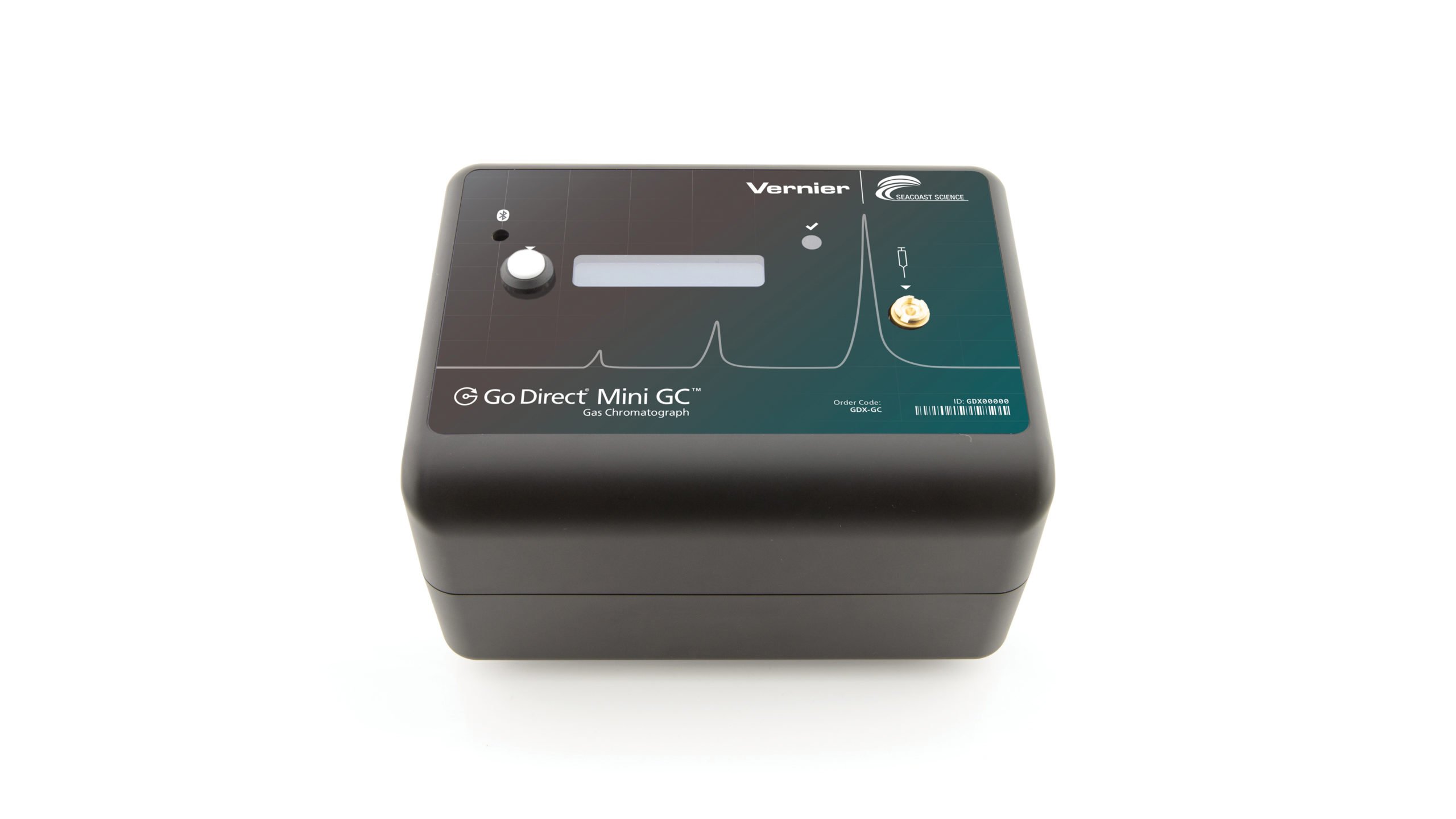
Go Direct® Mini GC™
Affordable, portable gas chromatograph built for the teaching lab. Uses ambient room air as carrier gas and a one-of-a-kind carbon-nanotube chemiresistive detector to separate and identify polar and non-polar compounds.
Includes: 1 µL Hamilton syringe · two replacement septa · USB cable and power supply · carrying case · free e-book with 5 ready-to-teach experiments
See it in action: easy enough to surprise even the veterans
In the webinar "Mixed Up No More: Achieving Clean Identification and Separation of Compounds with Your Go Direct® Mini GC™," Dr. Melissa Hill — the Vernier chemist who helped develop the product — demonstrates the instrument live alongside Nuce Essam, a chemistry and physics teacher with 34 years of classroom experience. They inject a four-compound mixture (ethyl acetate, cyclohexane, toluene, and butyl acetate) and show, in real time, how adjusting temperature and pressure separates peaks that come out bunched together at high temperature.
This same webinar is a great resource to send to your faculty ahead of a purchase conversation: it covers everything from the most common issues ("why isn't my GC giving peaks?" — almost always the septum) to how to design a temperature/pressure profile for a compound that isn't in the standard experiment list.
"The first time I used the new injection button, it blew me away compared to the old Mini GC Plus, where you had to fumble between the mouse and the syringe at the same time, a bit further from the unit. Now you guide the syringe in, press the plunger and the white button together, and you're done."— Dr. Melissa Hill, chemist and Senior Product Manager at Vernier
Curriculum ready from day one
The Go Direct Mini GC includes a free e-book with 5 ready-to-teach experiments, also available in editable Word format for anyone who registers their unit with Vernier. One of the most requested by departments evaluating the device is Using Gas Chromatography: Identifying an Unknown Compound — a great experiment to share directly with a department chair or lab coordinator, because it shows exactly what students will be doing: injecting known standards, recording their retention times, and then identifying an unknown sample from that reference library.
For university organic chemistry courses, the Mini GC integrates directly with Organic Chemistry with Vernier, the 26-experiment book — GC, spectrometry, polarimetry, synthesis, melting point, and spectroscopy — that Districalc already distributes across the region. Departments already using that curriculum don't need to design anything new: the Mini GC fits into experiments they may already be running.
"If you want your students to do quantitative work — identifying an unknown, determining a concentration — they need to inject each compound as a known standard first, under the exact same temperature and pressure profile, so they know what retention time to expect. That sets them up for success before you hand them the unknown."— Dr. Melissa Hill, chemist and Senior Product Manager at Vernier
From forensic chemistry to environmental analysis: real classroom applications
Beyond the organic chemistry lab, the Mini GC lends itself to interdisciplinary projects. Nuce Essam, co-author of a forensics book currently in development at Vernier, describes how that same known-standards logic becomes an investigative activity:
"In my forensics book, one of the activities is exactly that: students build their own small library of known compounds, and then analyze samples supposedly taken from suspects in an arson case, comparing their library to the unknown samples. The retention times are what identify the components."— Nuce Essam, chemistry and physics teacher (34 years of classroom experience)
Other courses use the Mini GC for environmental analysis — xylene mixtures and BTEX-type compounds — or simply to teach the fundamentals of the technique: what happens when you change the column temperature, what happens when you change the pressure, and why elution order closely tracks each compound's boiling point.
Districalc and Vernier: real gas chromatography at any university in Latin America
Districalc, an authorized Vernier distributor present in over 20 Latin American countries since 1981, offers the Go Direct Mini GC alongside the rest of Vernier's Go Direct® chemistry ecosystem — SpectroVis® Plus spectrophotometers, colorimeters, pH and conductivity sensors, polarimeters, and more — to universities and schools across the region.
If your institution wants to bring real gas chromatography into the undergraduate lab — no gas tank, no dedicated technician, no strain on the department budget — Districalc can support the whole process: equipment supply, teacher training, and local technical support.
Is your university evaluating the Go Direct Mini GC or the rest of Vernier's chemistry catalog? Contact us — Districalc works with universities, technical institutes, and schools in over 20 Latin American countries.
To go deeper: check out Vernier's technical breakdown of polar and non-polar compound detection and the technical comparison between the Mini GC Plus and the Go Direct Mini GC.
Ready to bring real gas chromatography into your university lab?
Districalc supplies Vernier's Go Direct Mini GC, teacher training, and technical support to implement it in your chemistry curriculum — in any country in Latin America.
Contact UsFrequently asked questions
At what university level is gas chromatography taught with Go Direct Mini GC?
Go Direct Mini GC is specifically designed for undergraduate lab courses in organic and inorganic chemistry. The article highlights that it integrates directly with the "Organic Chemistry with Vernier" curriculum, which contains twenty-six experiments. It is also suitable for interdisciplinary applications such as forensics, environmental analysis, and introductory analytical chemistry courses at Latin American universities. Its purpose is to bring real chromatography to undergraduate students without the infrastructure headaches that accompany traditional GC.
What carrier gas does Go Direct Mini GC require?
None. Go Direct Mini GC uses room air as the carrier gas, with no need for compressed gas tanks. This eliminates dependence on an external supply of helium, nitrogen, or other carrier gas, greatly simplifying lab logistics and reducing operating costs. Students connect the instrument to a laptop, tablet, or Chromebook via Bluetooth or USB, open the free Vernier Instrumental Analysis® app, and begin analyzing samples immediately, without additional lab infrastructure.
What types of compounds can Go Direct Mini GC detect?
Go Direct Mini GC (from 2020 onwards) detects both polar and nonpolar compounds. This is an advance over the earlier model (Mini GC Plus, 2012–2020) which only detected polar compounds like alcohols, esters, and ketones. The new carbon nanotube detector also allows detection of alkanes, aromatic hydrocarbons, and other nonpolar compounds. This opens important pedagogical applications: students can inject mixtures of polar and nonpolar compounds, observe their different retention times, and explore how temperature and pressure affect separation based on the nature of each molecule.
How many ready-to-teach experiments does Go Direct Mini GC include?
Go Direct Mini GC includes a free e-book with five ready-to-teach experiments, also available in editable Word format for those who register their equipment with Vernier. One of the most requested is "Using Gas Chromatography: Identifying an Unknown Compound," where students inject known standards, record their retention times, and then identify an unknown sample using that reference library. For institutions already using the "Organic Chemistry with Vernier" curriculum with twenty-six GC, spectrometry, and polarimetry experiments, the Mini GC integrates directly into experiments they likely already teach.
How does Go Direct Mini GC connect to the computer?
Go Direct Mini GC connects wirelessly via Bluetooth or by USB cable to any laptop, tablet, or Chromebook. Once connected, students open the free Vernier Instrumental Analysis® app to view, record, and analyze chromatography data in real time. The instrument is also compatible with LabQuest 2 and LabQuest 3, Vernier's traditional data acquisition devices. The ease of connectivity means students do not need special, expensive, or difficult-to-install software—they can use virtually any device available to them in the classroom or lab.