A real electric vehicle runs on 400 to 800 volts of direct current — 200 to 400 in hybrids — which makes direct student handling potentially lethal. Yet the research is clear: diagnostic competencies come from active, hands-on individual practice, not from watching the instructor do it. It's the same dilemma facing the whole automotive industry: by 2030 the International Energy Agency projects electric vehicles will account for nearly 40% of global new car sales,[1] and the methods built for teaching internal combustion engines simply don't work here — not for lack of will, but because an electric vehicle's physical, electrical and didactic nature is fundamentally different.
LJ Create's trainer series solves that paradox by functionally replicating every system in a real electric vehicle while scaling voltage down to safe learning levels: each student connects probes, inserts simulated faults, reads diagnostic parameters and practices high-voltage safety procedures in an environment where a mistake is a learning opportunity, not a medical emergency. The lineup covers battery, motor, charging-station and hybrid-system trainers, all with integrated digital curricula.
Opening the hood of an electric car: when less is a problem
One of the most powerful strategies in traditional automotive technical education has been to show. Opening the hood of a four-cylinder combustion engine and pointing to the block, visible pistons, crankshaft, camshaft, ignition system, and intake manifold is, in itself, a lesson. Students can see the movement, follow circuits visually, and build strong mental models from that first visual impression.
Open the hood of a modern electric vehicle and you will find… little. A power electronics module, perhaps an air conditioning compressor, some thick cables, and a sealed housing. All the magic happens inside encapsulated components that reveal nothing about their internal operation. There are no moving pistons, no distribution system to follow, no fuel flowing through visible channels.
A real electric vehicle has few visible moving parts. For a student who expects to understand a technical system by observing it, this represents an immediate pedagogical barrier.
Electric traction motors work on electromagnetic principles not visible to the naked eye. The high-voltage battery pack is protected by hermetic steel or aluminium housings. The inverter and battery management module operate with digital logic that requires specialized instrumentation to observe. The result is a vehicle that, from a pedagogical standpoint, looks like a "black box".
The safety factor: when touching can be deadly
The second challenge is potentially the most critical: safety. A workshop internal combustion engine presents manageable and well-known risks. An electric or hybrid vehicle is a completely different story.
Traction battery packs in pure electric vehicles typically operate between 400 V and 800 V of direct current, while hybrid systems generally range between 200 V and 400 V. NFPA 70E and the ISO 6469 and ISO 17409 standards establish strict insulation, lockout, and tagout (LOTO) protocols that a certified technician must master before touching any high-voltage component.[2]
⚠ Accidental contact with the high-voltage bus of an electric vehicle can cause cardiac arrest. The electric arc can produce third-degree burns in milliseconds. This is not an exaggeration: it is the reason vehicle manufacturers and regulatory bodies require mandatory specialized training for any technician working with these systems.
This creates a serious pedagogical paradox: we want students to learn by doing, but the "real object" of learning is potentially deadly if handled without the proper protective equipment and correct supervision. In many technical programs, the practical response has been that only the instructor touches the vehicle, while students observe from a safe distance.
The passive demonstration trap
Teaching based exclusively on demonstration — the instructor manipulates, students observe — is valid for certain stages of learning. But research in technical and vocational education is clear: diagnostic and problem-solving competencies are acquired primarily through active, individual practice.[3]
An automotive technician does not learn to diagnose a battery management system fault by watching their instructor use a multimeter. They learn by connecting the instrument themselves, interpreting readings, making safe mistakes, relating symptoms to causes, and developing the technical judgment that comes from accumulated experience.
When students cannot directly manipulate systems:
- They do not develop the muscle memory for safety procedures (LOTO, high-voltage personal protective equipment).
- They do not internalize the logical sequence of electrical diagnosis.
- They cannot identify fault symptoms in real time under controlled conditions.
- They graduate with theoretical knowledge but without practical confidence, making them less employable in a labor market that demands job-ready technicians.
See how LJ Create solves this challenge
The following video shows LJ Create's electric and hybrid vehicle trainers in action, with students directly interacting with the systems at safe voltages:
The solution: trainers designed for safe, hands-on learning
LJ Create, a British manufacturer founded in 1979 with over 45 years of experience in technical education equipment, designed its electric and hybrid vehicle trainer line specifically to solve this paradox. The design principle is elegant: replicate the real systems of an electric vehicle with functional accuracy, but scale voltages to safe levels for the learning environment.
This allows every student — not just the instructor — to connect probes, insert simulated faults, read diagnostic parameters, and develop high-voltage safety procedures in an environment where a mistake is a learning opportunity, not a medical emergency.
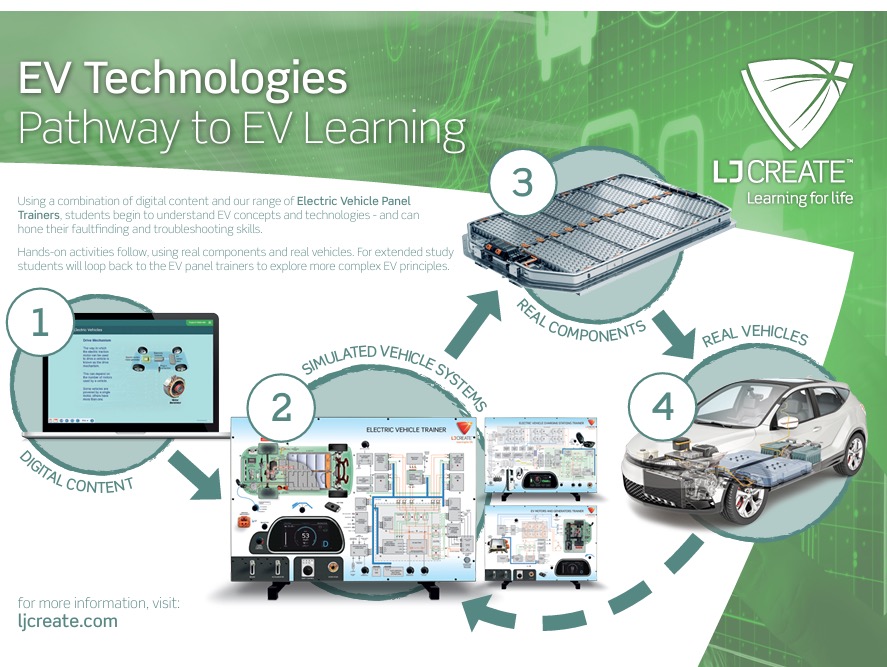
LJ Create electric series trainers
The following equipment, available through Districalc, official LJ Create distributor, forms a complete electric vehicle training ecosystem:
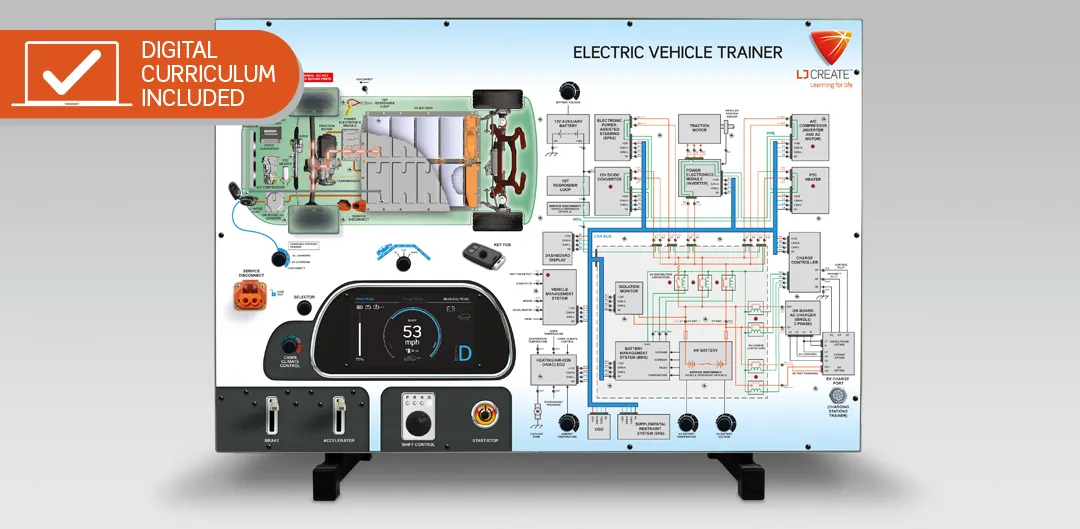
Entrenador de Panel – Sistemas de Vehículos Eléctricos (740-01)
Replicates the complete electrical systems of a typical EV: power flow, regenerative braking, onboard diagnostics, and fault simulation. The power flow mimic makes the invisible visible: students can observe how energy flows between the battery, inverter, and motors during acceleration, braking, and charging — something impossible to see in a real vehicle.
View product →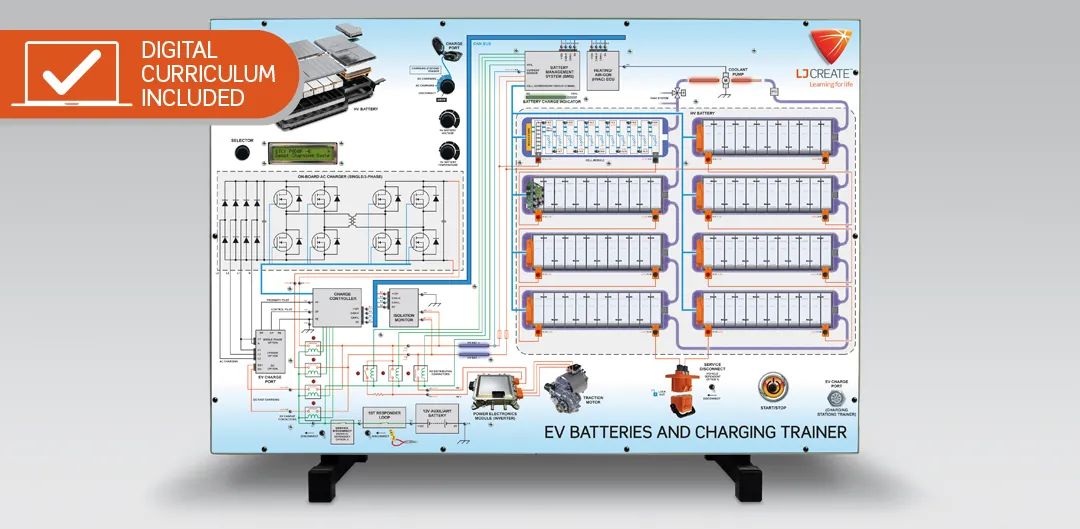
Entrenador de Panel – Baterías y Carga de VE (741-01)
Focuses on the most expensive and critical component of any electric vehicle: the high-voltage battery pack. Students explore the battery management system (BMS), cell balancing, temperature monitoring, and charge/discharge cycles, including regenerative charging, in a safe environment with scaled voltages.
View product →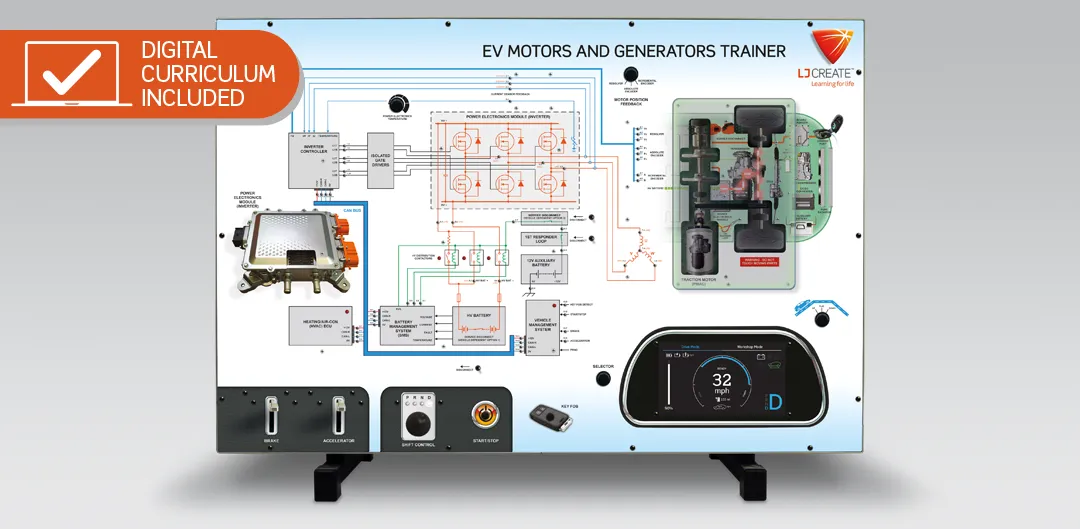
Entrenador de Panel – Motores y Generadores de VE (742-01)
Dedicated to the electrical heart of the vehicle: the three-phase traction motor. Students learn speed control using position and velocity sensors, the differences between motor and generator operation, and pre-configured scenarios that replicate real driving conditions. All with switchable faults for diagnostic exercises.
View product →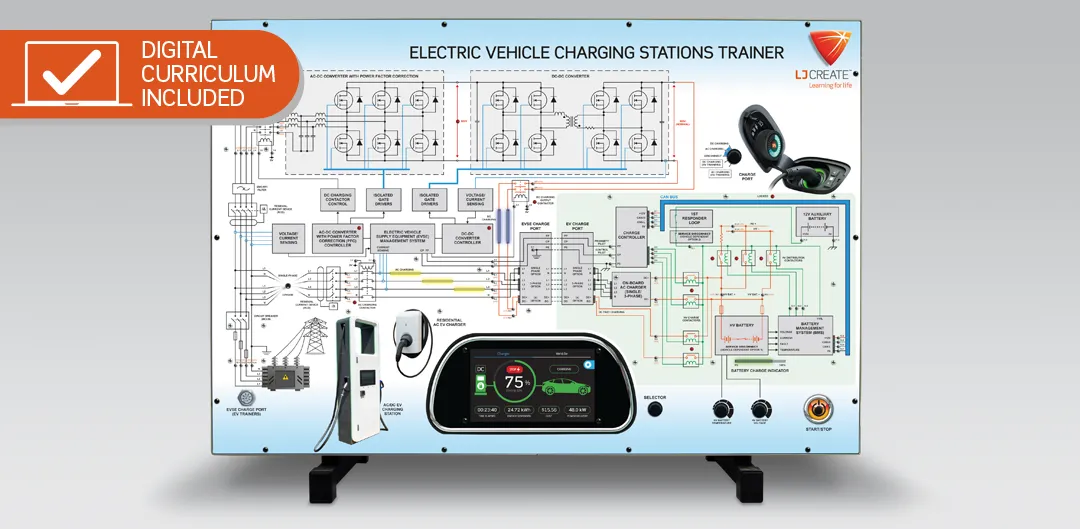
Entrenador de Panel – Estaciones de Carga para VE (743-01)
Charging infrastructure is the other half of the electrical ecosystem every modern technician must master. This trainer covers single-phase and three-phase AC charging, fast DC charging, and vehicle-to-station communications (EVSE), including handshake protocols and energy management, with scaled safe voltages.
View product →
Entrenador de Panel – Sistemas de Vehículos Híbridos (756-01)
For institutions also training technicians in hybrid technology — still dominant in the Latin American vehicle fleet — this trainer combines electrical system simulation with mechanical visualization, covering electric motors, regenerative braking systems, and power control modules.
View product →Integrated digital curriculum: beyond hardware
A distinguishing advantage of LJ Create over generic trainers is that every unit includes a complete digital curriculum: structured theory, step-by-step practical activities, instructor guides, and assessments. This is especially valuable in the EV context, where Spanish-language technical literature is scarce and instructors often lack prior training in high-voltage systems.
The materials cover everything from lithium-ion battery electrochemistry fundamentals to advanced diagnostic procedures with OBD scanners and oscilloscopes, following the logical progression that would take a student from zero to certified EV technician.
Preparing Latin America for the electric transition
For Latin America, the urgency is twofold. The region is experiencing accelerating electric vehicle adoption, particularly in urban public transit fleets: Mexico City, Bogotá, Santiago, and Buenos Aires already operate fleets of hundreds of electric buses. At the same time, the gap in specialized technical training is enormous.
The transition is advancing faster than the formation of a specialized technical workforce. According to the IDB, the energy transition will require significant reskilling and training of new technicians in the coming years.[4] Institutions that invest now in adequate training infrastructure will be positioned to meet that demand and to become references in next-generation automotive technical education.
Districalc, official LJ Create distributor with a presence in more than 20 countries since 1981, supports technical institutions in designing their electric vehicle laboratories, from equipment selection to curriculum implementation and instructor training.
LJ Create trainers allow every student to practice safely and individually. This is not a frontal demonstration: it is active learning, the only kind that produces competent technicians.
Ready to equip your electric vehicle program?
Districalc helps you design the automotive technology laboratory your institution needs. Inquire about available LJ Create trainers.
Contact UsFrequently asked questions
What is the main risk when working with electric vehicles in the classroom?
The main risk is high voltage. Traction battery packs in pure electric vehicles operate between 400-800 volts, and in hybrids between 200-400 volts. Accidental contact can cause cardiac arrest, and an electrical arc can produce third-degree burns in milliseconds. This is why NFPA 70E, ISO 6469, and ISO 17409 standards require mandatory specialized training.
Why is passive demonstration not enough to teach electric vehicle mechanics?
Research in technical education is clear: diagnostic and problem-solving competencies are acquired through active, individual practice, not by watching. If only the instructor manipulates while students observe, they don't develop muscle memory for safety procedures, don't internalize diagnostic logic sequences, and graduate without practical confidence or employability in the labor market.
How do LJ Create trainers solve the problem of teaching electric vehicles?
LJ Create trainers replicate the real systems of an electric vehicle with functional accuracy, but scale voltages to safe levels for the learning environment. This allows every student to connect probes, insert simulated faults, read diagnostic parameters, and develop high-voltage safety procedures in an environment where a mistake is a learning opportunity, not a medical emergency.
What equipment from the LJ Create series is available for electric vehicle education?
The complete series includes: Electric Vehicle Systems Trainer (740-01) with power flow visualization, Battery and Charging Trainer (741-01) focused on battery management, Motors and Generators Trainer (742-01) for the three-phase traction motor, Charging Stations Trainer (743-01) for AC/DC infrastructure, and Hybrid Vehicle Systems Trainer (756-01) for hybrid technology still dominant in Latin America.
Do LJ Create trainers include curriculum material?
Yes, each trainer includes a complete integrated digital curriculum: structured theory, step-by-step practical activities, instructor guides, and assessments. This is especially valuable because it covers everything from lithium-ion battery electrochemistry fundamentals to advanced diagnostic procedures, following a logical progression that takes students from zero to certified EV technician.
References
- International Energy Agency (IEA). Global EV Outlook 2024. Paris: IEA, 2024. Disponible en: iea.org/reports/global-ev-outlook-2024
- National Fire Protection Association. NFPA 70E: Standard for Electrical Safety in the Workplace. Quincy, MA: NFPA, 2024. Véase también ISO 6469:2023 – Electrically propelled road vehicles – Safety requirements, e ISO 17409:2023 – Electrically propelled road vehicles – Connection to an external electric power supply – Safety requirements.
- Kolb, D. A. Experiential Learning: Experience as the Source of Learning and Development. Englewood Cliffs, NJ: Prentice Hall, 1984. Para aplicaciones en formación técnica vocacional, véase también CEDEFOP. Vocational Education and Training for the Future of Work. Luxembourg: Publications Office of the EU, 2022.
- Banco Interamericano de Desarrollo (BID). Los efectos de la transición energética en el empleo del sector eléctrico en América Latina. Washington: BID, 2023. Disponible en: publications.iadb.org