Imagine getting a kit with everything you need to make a car run at high speed — powered only by water. No gasoline, no lithium batteries: just water that, through electrolysis, turns into hydrogen to feed a fuel cell that propels the vehicle down a 10-meter track. That's the starting point of the H2 Grand Prix Sprint, the program from Horizon Educational that turns the renewable-energy classroom into an engineering, digital-fabrication and international-competition lab.
The base kit hands every team twelve identical cars, and that's where the real question starts: how do I make mine faster? Answering it means putting the school's maker lab to work — 3D printer and laser cutter — designing more aerodynamic bodies, printing lighter mounts, and modifying components, testing on the track, watching the result land on a live world ranking, and repeating the cycle. The digital fabrication lab stops being a room with no purpose and becomes the team's engineering workshop.
The kit: all you need is water
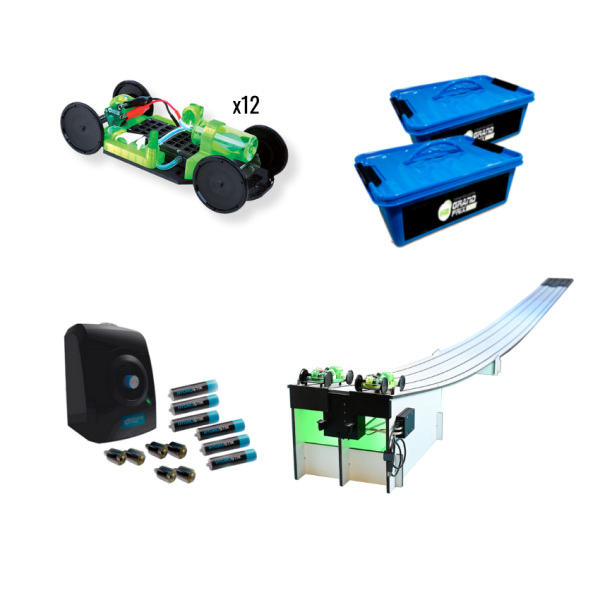
The H2GP Sprint Car Kit (RESK-03-1) is a 1:20 scale racing car powered by a proton exchange membrane (PEM) hydrogen fuel cell. The propulsion system works like this: the Hydrofill station electrolyzes tap water to produce pure hydrogen, which is stored in a small HYDROSTIK cartridge; that cartridge feeds the car's fuel cell, which converts hydrogen into electricity to drive the motor. The only byproduct of the cell is water vapor. Zero emissions.
The kit includes all the parts and is ready to assemble and race: students build it themselves, and that assembly is already the first engineering experience. Once assembled, the car is ready to compete. Unlike conventional demonstration experiments, the H2GP Sprint is explicitly designed to be modified. The chassis, body, drivetrain components and mass distribution are all variables that students can intervene in. The challenge is not just understanding how hydrogen works — it is applying that knowledge to win.
The electrochemistry of hydrogen stops being abstract the moment tenths of a second matter. When the team understands that every misused milliliter of hydrogen costs them positions on the leaderboard, thermodynamics becomes urgent.
Engineering at the limit: three levers to go faster
The H2GP Sprint has no single path to victory. Teams can intervene in the car in three main dimensions, and finding the optimal combination of the three is the engineering problem each team must solve:
Motor & efficiency
Optimizing fuel cell consumption, adjusting the gear ratio and reducing internal friction are interventions that directly impact top speed and race-to-race consistency.
Weight balance
Mass distribution affects traction at launch and straight-line stability. Teams can redistribute components or use lighter materials in non-structural parts to improve the power-to-weight ratio.
Aerodynamics
On a 10-meter track, drag is a real factor. Modifying the body to reduce air resistance — or adding surfaces that generate downforce — can be the difference between first and second place.
These are not simulations. They are engineering decisions with measurable consequences: the track timer does not lie. Every team hypothesis becomes a test, and every test becomes data. That is how students develop the engineering mindset that no textbook can replace.
Maker labs enter the picture: from 3D files to the track
This is where H2GP Sprint becomes something truly different. Horizon Educational provides the 3D model files of the kit to participating teams. This means students are not limited to the components that come in the box: they can design, print and test their own parts using the digital fabrication infrastructure their school already has.
A new aerodynamic body designed in CAD and 3D-printed. A lighter fuel cell mount cut from wood with a CNC router. A side deflector made with low-density filament to reduce weight without sacrificing rigidity. The school's digital fabrication lab — what many institutions call a maker lab or fab lab — goes from being an underused resource to being the team's engineering workshop.
Horizon provides the files. The school provides the 3D printer, CNC router or laser cutter. Students provide the creativity. The result is real manufacturing aimed at real outcomes — exactly what an international competition demands.
This integration between the H2GP Sprint program and the school maker lab is one of the most powerful dimensions of the project. It turns the hydrogen competition into the perfect reason to activate all the digital fabrication resources that many schools already own but rarely use with such a concrete purpose: design parts, test them under competitive conditions and improve them based on real data.
CNC wood routers, resin printers, laser cutters, thermoforming equipment: each of these tools, often underused in the technology workshop, finds an immediate and motivating application in H2GP Sprint. There is no better way to teach digital fabrication than when the product is going to compete against teams from another continent.
The track that connects to the world: real-time ranking
The H2GP Sprint Competition Package (RESK-03-CP) competition track is not just a 10-meter lane. It is the interface between the team's engineering work and the world. The track records each race time with precision and automatically uploads it to the H2GP Sprint world ranking. The moment the car crosses the finish line, the result is visible to competitors in any country.
This radically transforms the nature of competition. A school in Santiago, Lima, Buenos Aires or Mexico City can participate in a truly global challenge without incurring the travel costs that an in-person international competition would require. The locality of the race does not limit the reach of the competition: what the track timer records at a technical high school in Biobío is immediately available to a team in Europe or Asia.
The real-time world ranking eliminates one of the historic barriers to international competitions: travel costs. Any school with an H2GP Sprint kit can compete at the highest global level from its own laboratory.
For students, seeing their position on a world ranking after each race has a motivational effect that no exam can replicate. The presence on that ranking is immediate, objective and public. That is exactly the kind of incentive that turns a school project into a team mission.
H2GP Sprint in action
The following video shows the H2GP Sprint in action: hydrogen cars racing on the 10-meter competition track, the race dynamics and the educational potential of the program.
The International H2 Grand Prix Sprint Championship
Horizon Educational organizes the International H2 Grand Prix Sprint Championship, where the top teams from the world ranking face off in the ultimate competition. The championship winner receives an H2GP Pro kit as a prize — the highest-tier system in the H2GP ecosystem, designed for high-performance educational programs.
Chile participated in the first international H2GP Sprint competition in March 2026, consolidating its presence in the program at the global level. This participation positions Chile as the only country in Latin America with active teams competing in the program's official world ranking. For Chilean teams — the vast majority from technical-vocational high schools — reaching that international ranking is an achievement that goes beyond school and has a real impact on their educational and professional trajectories.
The goal for coming years is clear: add more Chilean teams to the ranking, and expand the program to new Latin American countries. The first participation is the proof of concept. What comes now is scaling up.
Districalc: official Horizon distributor in Latin America
Districalc is the official distributor of Horizon Educational in Latin America, with a presence in more than 20 countries in the region since 1981. This means that schools, technical high schools and universities in Latin America that want to implement the H2GP Sprint program have in Districalc a local partner that not only supplies the kit, but also accompanies the pedagogical integration process, trains teachers and facilitates participation in the world ranking.
The H2GP Sprint Competition Package (RESK-03-CP) includes everything a school needs to host its first competition: 12 scale hydrogen cars, the 10-meter competition track, the Hydrofill station and all accessories. For institutions that want to start with smaller groups or in an exploratory way, the H2GP Sprint Classroom Pack (RESK-03) and the individual H2GP Sprint Car Kit (RESK-03-1) are the ideal entry points.
If your institution already has a 3D printer, a laser cutter or a digital fabrication workshop, H2GP Sprint can turn that equipment into the engine of a world-class educational experience. And if you are thinking about how to activate your school's maker lab with a project that combines renewable energy, applied engineering and international competition — this is exactly the opportunity you are looking for.
Ready to bring H2GP Sprint to your institution?
Districalc is the official Horizon distributor in Latin America. Contact us to learn about the available kits, the implementation process, and how to join the world ranking.
Contact UsFrequently asked questions
What grades and courses teach H2GP Sprint in schools?
H2GP Sprint targets renewable energy classes and digital fabrication programs (maker labs) in secondary education. The article does not specify an exact age, but describes the program functioning in schools equipped with digital fabrication infrastructure—3D printers, laser cutters, CNC routers—which typically situates the program in technical secondary schools or schools with design and engineering resources. The pedagogical goal is to transform those digital fabrication labs, often underutilized, into an active engineering workshop with real competitive purpose.
How does the school maker lab integrate with H2GP Sprint competition?
Horizon Educational provides teams with 3D model files for the kit. This allows students to not be limited to just the components in the box but to design, print, and test their own parts using their school's digital fabrication infrastructure: new aerodynamic bodies CAD-designed and 3D-printed, lighter supports cut in wood with CNC routers, side deflectors in low-density filament. The school's fabrication lab transforms from an underutilized resource into the team's engineering workshop, with design, test, and improvement cycles guided by real track data.
What is the length of the H2GP Sprint competition track?
The H2GP Sprint competition track is ten meters long. It is a precisely timed track that records each tenth of a second, and automatically uploads results to the H2GP Sprint global ranking in real time. Though short, the stopwatch does not lie: every engineering change a team makes is immediately reflected in the times, providing concrete data for the design and test iteration cycle that characterizes the program.
Do students need to travel for international competitions?
No. The H2GP Sprint global ranking allows teams to compete globally without incurring international travel costs. Each school's ten-meter track is connected to the ranking in real time: when students race their car locally, the result immediately appears visible to competitors in any country. This radically transforms the nature of international competition, eliminating a historical barrier: the locality of the race does not limit the global reach of the competition.
What consumables or replacement parts does H2GP Sprint require?
The program requires HYDROSTIK cartridges that store hydrogen to power the cars' fuel cells. The article does not specify the exact replacement frequency, but describes how each team must refuel from the Hydrofill station between races. There are also replacement septa mentioned in the included kit. Consumable costs are modest compared to a traditional vehicle competition program requiring gasoline, lubricants, and engine maintenance.
References
- Horizon Educational. H2GP Sprint Competition Package (RESK-03-CP). Available at: horizoneducational.com
- H2 Grand Prix International. H2GP Sprint World Ranking. Available at: h2grandprix.com
- Horizon Educational. H2GP Sprint 3D Model Files for Customization. Available at: horizoneducational.com/h2gp-sprint