An electrolyzer splits water into hydrogen and oxygen using electricity; a fuel cell does the exact opposite: it takes that hydrogen, splits it into protons and electrons, and lets the electrons flow through an external circuit to generate the current that drives a motor, while the protons recombine with oxygen to form water as the only byproduct. No combustion, no carbon, just water — and that reversible cycle is, essentially, everything that makes an H2 Grand Prix Pro car run.
In this technical interview, we sat down with Camilo Wartenberg, Director for Latin America at H2 Grand Prix, to talk about how that on-track propulsion system actually works. The goal: to explain, with the level of detail a teacher or engineering student needs, the full path from the fuel cell to the electrolyzer that produces the hydrogen right in the school workshop.
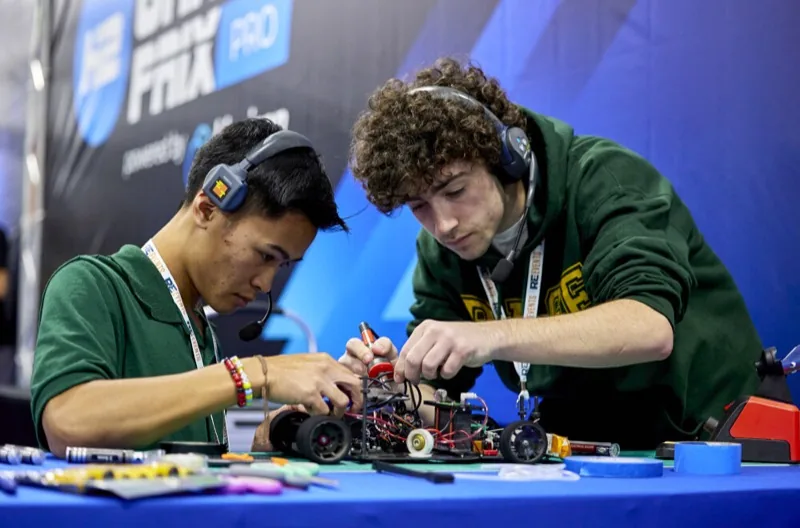
The fuel cell: the car's hybrid heart
1. What exactly is H2 Grand Prix Pro, and what does a school or university that enrolls receive?
H2 Grand Prix Pro, or H2GP Pro, is Horizon Educational's hydrogen car racing program. It isn't just a competition — it's a complete engineering laboratory handed to each team. When a technical high school or university enrolls, it receives an RC car kit built at roughly one-tenth the scale of a real vehicle, with a chassis, motors, an RF controller, power electronics and, most importantly, a complete hydrogen fuel cell system. On top of that comes a benchtop electrolyzer that lets the team produce its own hydrogen right in the workshop or lab, without depending on anyone shipping it to them pre-bottled. It is, literally, a classroom-scale hydrogen power station.
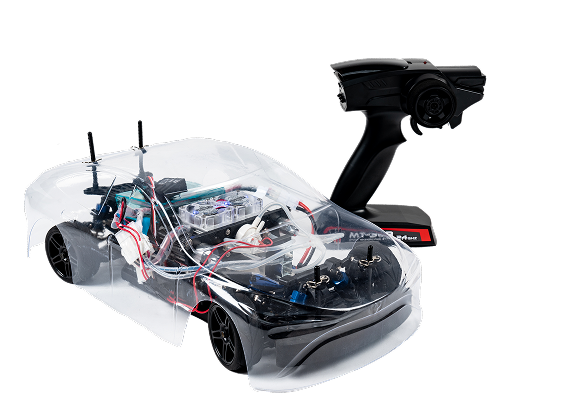
2. You mentioned the car is a hybrid. What does it resemble in the real world?
Conceptually it works exactly like the hydrogen vehicles already on real roads, like the Toyota Mirai or the BMW iX5 Hydrogen: a system where the fuel cell doesn't replace the battery, but works alongside it. Within the H2GP Pro rulebook itself there's actually a category called Hybrid, where the team has to balance the power the fuel cell delivers against a battery and supercapacitors that absorb spikes in energy demand — for example when accelerating or coming out of a corner. That is exactly the same engineering problem that real hydrogen car manufacturers solve: the fuel cell delivers stable, continuous power, but a car needs instantaneous power spikes, and that's where the hybrid system comes in.
3. Let's talk about the heart of the system, the fuel cell. How does it work and what power does it deliver?
The fuel cell these vehicles use is a 30-watt PEM cell — proton exchange membrane. It's a stack of fourteen individual cells connected in series, very compact, delivering around 8.4 volts at 3.6 amps at its peak. The way it works is elegant: hydrogen goes in on one side, oxygen from the air goes in on the other, and inside the membrane a controlled electrochemical reaction splits the hydrogen into protons and electrons. The electrons are forced to travel through an external circuit — that's the electric current that drives the car — and at the end of the process, protons, electrons and oxygen recombine to form water as the only byproduct. There's no combustion, no carbon emissions, and the only thing that comes out of the tailpipe, if you can even call it that, is water vapor.
The hydrogen cycle: from electrolyzer to track
4. Besides the car, you mentioned they receive an electrolyzer. What is it, and how does it relate to the HydroFill?
The electrolyzer is the piece that closes the educational loop. The HydroFill is also a PEM-type electrolyzer, but it runs in reverse compared to the fuel cell: instead of combining hydrogen and oxygen to generate electricity, it takes electricity from the grid and distilled water, and uses that electricity to split the water molecule into hydrogen and oxygen. The hydrogen produced isn't stored as compressed gas at high pressure, which would be dangerous in a school workshop — instead it's loaded into metal hydride cylinders, among the smallest and most compact hydrogen cylinders that exist for educational use. These cylinders absorb the hydrogen in a solid state, inside the metal hydride's structure, at low pressure. That makes them extraordinarily safe: they're cylinders approved even for air transport under IATA regulations, something that would be unthinkable with a conventional compressed-gas cylinder. For students, this means they can manufacture, store and transport their own fuel inside the same school building, at a level of risk comparable to a rechargeable battery.
HydroFill's metal hydride cylinders are approved for air transport under IATA regulations — a level of safety unthinkable with conventional compressed hydrogen, and comparable to a rechargeable battery.
5. How does this connect to what students learn about electrolysis?
That's where the program's real pedagogical value lies: students see both sides of the same chemical reaction working on the same workbench. Through electrolysis, they learn to split the water molecule, H₂O, into its two components — hydrogen at the cathode and oxygen at the anode — using electric current. Then, in the fuel cell, they see exactly the reverse reaction: hydrogen and oxygen recombine to release that same energy as electricity, plus water as a byproduct. It isn't a theory class about the hydrogen cycle — it's the hydrogen cycle happening physically in front of them, with instruments they assemble, test and tune themselves.
Race engineering: weight, aerodynamics and energy management
6. Beyond the chemistry, what engineering concepts do teams apply to improve the car?
That's where the program becomes a real engineering project and not just a lab experiment. Teams have to solve the same kinds of decisions any automotive engineer faces: where to place the fuel cell and the hydrogen cylinder to get the right weight distribution between the axles, how to reduce the bodywork's aerodynamic drag, what gear ratio to use to balance torque and top speed, and how to electronically manage the power split between the fuel cell and the battery so as not to waste hydrogen on stretches where maximum power isn't needed. Every extra gram of hydrogen they burn means one more pit stop, and every pit stop means lost time on track. So they end up optimizing the car not just to be fast, but to be energy-efficient — which is exactly the same challenge the hydrogen automotive industry faces today at full scale.
7. And on the track — how does the race itself, the competition format, work?
The format is endurance-style, like the 24 Hours of Le Mans. The official H2GP Pro rulebook allows races of between two and six hours — the World Final runs six — and in the Latin American editions we coordinate, we typically race a four-hour continuous format. It isn't the fastest car on a single hot lap that wins — it's the team that completes the most laps within that time. That completely changes the strategy: a car can be very fast, but if it burns too much hydrogen and has to pit more often to refuel, it ends up losing to a slower but more efficient car that spends less time stopped. It's exactly the same logic that governs real endurance racing: fuel management, thermal management of the system, pit-stop planning and consistency over hours, not just top speed. That's why H2GP Pro ends up being, in practice, an intensive course in energy systems engineering applied to a real vehicle — just at the scale of a workbench and a technical high school.
The program on the track: H2 Grand Prix Chile 2024
The following video, recorded by the Districalc team, shows Chilean teams competing at H2 Grand Prix Chile 2024 — from pit-lane setup to on-track action.
Does your school want to compete in H2 Grand Prix Pro?
Districalc distributes the H2GP Pro kits and the HydroFill electrolyzer across Latin America, and supports technical high schools and universities from enrollment all the way to the track. Contact us to bring this hydrogen engineering lab to your institution.
Contact UsFrequently asked questions
What exact equipment does a secondary school or university receive when enrolling in H2GP Pro?
H2GP Pro is a complete engineering lab kit: an RC car at approximately 1:10 scale with chassis, motors, radio frequency controller, power electronics, and a thirty-watt hydrogen fuel cell system. It includes a benchtop HydroFill electrolyzer that enables students to produce their own hydrogen in the workshop or lab without relying on external supplies. It is literally a classroom-scale hydrogen energy station, ready for students to design, build, test, and race on competition tracks.
Is it safe to use hydrogen in a classroom or school workshop?
Yes. The system uses metal hydride cylinders that store hydrogen in solid state within the metal structure at low pressure. These cylinders are approved for air transport under IATA standards—a level of safety unthinkable with conventional compressed hydrogen. The risk is comparable to a rechargeable battery. It requires no high-pressure compressed gas tanks or special safety infrastructure that would be beyond the reach of a typical school workshop.
How much power does the H2GP Pro fuel cell deliver?
The fuel cell is a thirty-watt PEM (proton exchange membrane) cell composed of fourteen individual cells connected in series. It delivers approximately 8.4 volts at 3.6 amperes at its peak point. Its operation is electrochemical: hydrogen splits into protons and electrons, the electrons travel through an external circuit generating the electric current that powers the car, and the protons recombine with oxygen producing water as the only byproduct. There is no combustion, no carbon emissions.
How long does a race last in H2GP Pro format?
The race format is endurance-style, following the model of the 24 Hours of Le Mans. The official rules allow races of two to six hours; the global final runs six hours. In editions coordinated in Latin America, competition typically happens in a four-hour continuous format. The winner is not the car with the fastest single lap, but the team that completes the most laps within the allowed time. This demands strategic fuel management, pit stops, and energy efficiency.
Can students produce their own hydrogen in the workshop?
Yes. HydroFill is a PEM-type electrolyzer that works in reverse of the fuel cell: it takes electricity from the grid and distilled water, and uses that electricity to break the water molecule into hydrogen and oxygen. The hydrogen is loaded into compact and safe metal hydride cylinders. Students see both sides of the same chemical reaction at the same workbench: electrolysis in the HydroFill to produce hydrogen, then the fuel cell reversing that reaction to generate electricity. It is pure pedagogy of the hydrogen cycle happening physically before them.
References
- Horizon Educational. H2GP Pro — Technical Specifications. Available at: h2grandprix.com
- International Air Transport Association (IATA). Dangerous Goods Regulations — provisions for metal hydride storage systems.
- Toyota Motor Corporation. Mirai Fuel Cell Technology Overview. Available at: toyota.com
- H2GP / Horizon Educational. Official H2GP Pro Rulebook — race format and duration. Available at: h2gp.org/programs/h2gp-pro