Green chemistry is defined as the design of chemical products and processes that reduce or eliminate the use and generation of hazardous substances. It isn't a label you slap on a lab after it's already built — it's a different way of framing the problem from the start: instead of asking "how do I run this experiment safely?", green chemistry asks "how do I design this experiment so it doesn't need to be hazardous in the first place?"
That shift in mindset has a name within the education community: "beyond benign." It isn't enough to neutralize an existing risk — the goal is to design processes that are inherently safe and sustainable from the very first step. In this article we explain what green chemistry is, its foundations, and how Vernier — in collaboration with the nonprofit Beyond Benign — turned that philosophy into a complete lab kit for the classroom.
What is green chemistry — and what does "beyond benign" mean?
Green chemistry doesn't replace traditional chemistry — it redesigns it. The same equilibrium, Beer's Law, or electrochemistry experiment can be taught with toxic reagents and heavy waste output, or it can be taught — with the same data rigor — using low-risk materials, reduced scales, and renewable-sourced substances. The educational outcome is identical; what changes is what goes into and comes out of the lab.
The nonprofit Beyond Benign is the organization that gave this idea its pedagogical structure. Its mission is to develop and disseminate green chemistry educational resources, and to empower teachers, students, and entire communities to practice sustainability through chemistry — from the secondary classroom to the university lab. The organization's name sums up the whole philosophy: it isn't enough for a process to be accidentally "benign" or harmless; sustainability has to be intentionally designed in from the start, going "beyond" the mere absence of harm.
Beyond Benign maintains dedicated portals for K-12 and higher education, plus the Green Chemistry Teaching and Learning Community (GCTLC), a collaborative platform where educators worldwide share experiments, connect, and grow within the green chemistry community.
The foundations: the 12 Principles of Green Chemistry
The conceptual foundation behind all of this is the 12 Principles of Green Chemistry, formulated in 1998 by chemists Paul Anastas and John Warner. They aren't an environmental-compliance checklist — they're a design framework that guides every decision, from which reagent to choose to how to scale a reaction, toward inherently safer and more efficient processes.
A teacher doesn't need to apply all 12 principles at once. Beyond Benign recommends starting with manageable changes: redesigning a single lab with lower-toxicity reagents, scaling down an experiment to minimize waste without losing the analytical opportunity, or simply spending a few minutes discussing one or two principles during the relevant unit. Many green chemistry experiments also turn out to be cheaper and safer because they use everyday materials that eliminate hazardous-waste disposal costs.
The kit: Vernier Green Chemistry Starter Package
Vernier turned this philosophy into a concrete lab package, developed in collaboration with Beyond Benign: the Green Chemistry Starter Package. It teaches three core general-chemistry units — equilibrium, Beer's Law, and electrochemistry — with no gas lines, no fume hood, and no handling of hazardous reagents, while keeping the same data quality and rigor as a traditional lab.
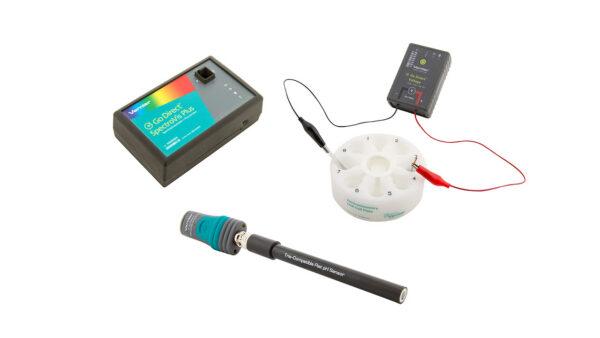
Green Chemistry Starter Package
Educational package that combines Go Direct® sensors with curriculum materials developed together with Beyond Benign, to teach equilibrium, Beer's Law, and electrochemistry in an environmentally responsible way.
Includes
Recommended software: Vernier Graphical Analysis Pro and Vernier Spectral Analysis
What sets this package apart isn't just the hardware — it's the three lab experiences developed together with Beyond Benign, each shipping with complete instructions and a teacher guide, and each designed to teach a traditional general-chemistry concept while swapping out the usual reagents for lower-risk alternatives:
- "Why Did My Tea Turn Purple?" — chemical equilibrium using plant-based natural indicators.
- "Sustainable Spectroscopy" — Beer's Law using everyday solutions, with no specialized lab reagents.
- "Green Chemistry and the Electrochemical Series" — cell potential measurement with a low-waste approach.
Beyond Benign and Vernier also run an open call for educators worldwide to submit their own green chemistry experiments featuring Vernier technology to the GCTLC platform — a way for the education community to keep expanding this catalog of sustainable experiences.
In the classroom: "Why Did My Tea Turn Purple?" — chemical equilibrium without hazardous reagents
One of the kit's three experiments is also one of the clearest examples of what it means to design "beyond benign." Traditionally, teaching chemical equilibrium in the lab means working with metal complexes like iron(III) thiocyanate — an effective reagent, but a toxic one that generates heavy-metal waste. The purple-tea experiment achieves the same pedagogical goal using butterfly pea tea, a plant-based, non-toxic, food-safe material.
The tea contains anthocyanins, plant pigments whose molecular structure changes with the pH of the medium. Those structural changes alter how the molecules interact with light, producing distinct colors under acidic, neutral, and basic conditions — from deep purple to pinks and greens, depending on pH. As Vernier chemist Dr. Melissa Hill explains: "equilibrium is dynamic. Even when a solution looks stable, molecular reactions are still happening."
"Equilibrium is dynamic. Even when a solution looks stable, molecular reactions are still happening."— Dr. Melissa Hill, chemist and Senior Product Manager at Vernier
The experiment directly addresses three misconceptions common among students: that equilibrium means reactions stop, that a color change signals the reaction is complete, and that adjusting pH simply makes a solution "more acidic" or "more basic" rather than shifting the position of the equilibrium. Through a phenomenon visible to the naked eye, students connect Le Châtelier's Principle and the concept of pKa to real quantitative data.
Classroom procedure
- Qualitative prep: six tea samples are prepared with different additives — lemon juice, vinegar, baking soda, Sprite, Alka-Seltzer — and immediate color shifts are observed.
- pH measurement: the pH of each sample is quantified with the Go Direct® pH sensor, connecting the numerical data to the observed color.
- Absorbance spectra: each sample's spectrum is measured with the Go Direct® SpectroVis® Plus spectrophotometer, identifying how the peak wavelength shifts with pH.
- Advanced analysis (optional): more advanced students plot absorbance at a specific wavelength against pH to estimate the anthocyanins' pKa value.
The entire data flow runs on the free Vernier Graphical Analysis and Vernier Spectral Analysis apps, with the pH sensor and the SpectroVis Plus connected via Bluetooth or USB — the same Go Direct® ecosystem Districalc already distributes for physics, biology, and chemistry across the region.
Districalc and Vernier: real green chemistry for schools and universities in Latin America
Districalc, an authorized Vernier distributor present in over 20 Latin American countries since 1981, offers the Green Chemistry Starter Package alongside the rest of Vernier's Go Direct® chemistry ecosystem — spectrophotometers, pH and conductivity sensors, gas chromatography, electrochemistry, and more — to educational institutions across the region.
If your institution wants to bring green chemistry into the curriculum — whether by redesigning a single lab or adopting the full kit developed with Beyond Benign — Districalc can support the whole process: equipment supply, teacher training, and local technical support.
Is your institution evaluating the Green Chemistry Starter Package or the rest of Vernier's chemistry catalog? Contact us — Districalc works with universities, technical institutes, and schools in over 20 Latin American countries.
To go deeper: check out Vernier's guide on getting started with green chemistry, the Green Chemistry Starter Package product page, and the full article on the purple-tea equilibrium experiment.
Ready to bring green chemistry into your lab?
Districalc supplies Vernier's Green Chemistry Starter Package, teacher training, and technical support to implement it in your chemistry curriculum — in any country in Latin America.
Contact UsFrequently asked questions
What are the safety requirements to implement a green chemistry lab?
Green chemistry eliminates the need for many hazardous chemicals by redesigning experiments from the ground up. Vernier's Green Chemistry Starter Package, developed with Beyond Benign, uses low-risk materials and inherently safe processes. A three-year pilot at St. Olaf College showed a 30% reduction in hazardous waste after introducing green chemistry labs.
What does 'beyond benign' mean and how does it apply in the classroom?
Beyond Benign means designing chemical processes to be inherently safe from the start, not just minimizing existing risks. In the classroom, this means choosing low-risk reactants, reducing scales to minimize waste, using renewable materials when possible. The educational outcome is identical to traditional chemistry, but without the hazards or waste volume.
What is an example of a green chemistry experiment that can be done in the classroom?
Vernier's Green Chemistry Starter Package includes a purple tea experiment that teaches chemical equilibrium without hazardous chemicals. This experiment demonstrates how pH changes affect natural indicator colors, allowing students to observe equilibrium reactions in complete safety using everyday materials.
What teacher preparation is needed to teach green chemistry?
Beyond Benign recommends starting with manageable changes: redesigning a single lab with lower-toxicity reactants, reducing scale without losing analytical opportunities, or spending a few minutes discussing one or two principles during relevant units. Green chemistry experiments often cost less because they eliminate hazardous waste disposal costs.
What are some of the 12 Principles of Green Chemistry that teachers should know?
Among the 12 principles are: prevention (avoiding waste rather than treating it), atomic economy (maximizing atoms in the final product), less hazardous synthesis (using low-toxicity substances), design of safer solvents, energy efficiency, use of renewable feedstocks, and real-time analysis. These principles, formulated in 1998, guide the design of inherently safer processes.