What happens when students stop calculating loads on paper and watch, in real time, a balsa-wood bridge hold — and finally give way — under hundreds of newtons of force? A bridge-building competition equipped with Vernier's Go Direct® Structures & Materials Tester (GDX-VSMT) turns structural design into a concrete, measurable experience: clear rules on dimensions, materials and maximum bridge weight, an evaluation criterion based on structural efficiency — load supported divided by weight — and a four-phase engineering design cycle: plan, build, verify with real load data, and redesign.
No lab experiment packs in so many concepts at once: material strength, force distribution, compression, tension, buckling, truss geometry, and above all the humility of watching something that looked solid on paper fail in reality over a detail nobody saw coming. An instrument that measures forces up to a thousand newtons and logs deflection in real time turns that moment of failure into data — and data into genuine learning.
Why bridge competitions work so well as a pedagogical tool
Mark Wechter, engineering teacher at Riverdale High School (Portland, Oregon) and two-time winner of the Illinois Institute of Technology International Bridge Competition, describes the key to his program with a single phrase he tells students from the first day: "It's your bridge." That transfer of ownership over the design is what turns the competition into a genuine formative experience.
The pedagogical value of bridge competitions comes from their inherent structure: clear objective, real constraints, and an evaluation impossible to fake — the bridge holds or it doesn't. No subjective grades. The result speaks for itself.
The balance Wechter describes is precise: you need to give enough initial instruction for students to understand how a truss works — without designing their bridge for them. The competition only works when students make their own decisions, make their own mistakes, and learn from those mistakes.
The engineering design cycle: Plan, Do, Check, Act
A well-designed bridge competition does not end at the moment of failure — it starts there. The Go Direct® Structures & Materials Tester makes possible something traditional methods (the weight bucket, the lab tables) do not: non-destructive testing that identifies weak points without destroying the structure.
This directly activates the engineering design cycle that every technical training program should integrate:
This cycle — also known as PDCA — is exactly what civil engineers use on real projects. The difference is that in the classroom, feedback arrives in minutes, not weeks.
From beams to trusses: what students discover by measuring
Before building the bridge, the best competition programs invest time understanding the structural elements that compose it. This can be done experimentally, with the GDX-VSMT and the Truss Tester accessory, in just a few classes:
- Rectangular beams: students verify that the same piece of wood is much stiffer placed on its edge. Doubling the section height increases stiffness by a factor of eight (h³). This fact radically changes design decisions.
- Composite beams: comparing a solid beam with an I-beam or box beam reveals why real steel bridges are not solid bars — material distribution matters as much as quantity.
- Triangular trusses: with the VSMT-TRUSS, students build trusses at different angles and take them to failure. A shallow-angle truss resists more vertical force but exerts greater horizontal thrust on its supports.
- Failure mode: observing how each structure breaks reveals which member is in compression (buckling) and which is in tension (fracture). That information directly guides reinforcement.
The free e-book Materials Testing: Beams to Bridges, included with every GDX-VSMT, contains all these NGSS-aligned investigations. It's not a theory manual — it's a laboratory activity guide that students complete before designing their first competition bridge.
Product profile: Go Direct® Structures & Materials Tester (GDX-VSMT)
The Go Direct® Structures & Materials Tester is the reference structural testing platform for civil engineering, construction, and bridge competition educational programs. It combines a high-resolution force sensor with a precision displacement sensor in a portable unit with Bluetooth® or USB connectivity.
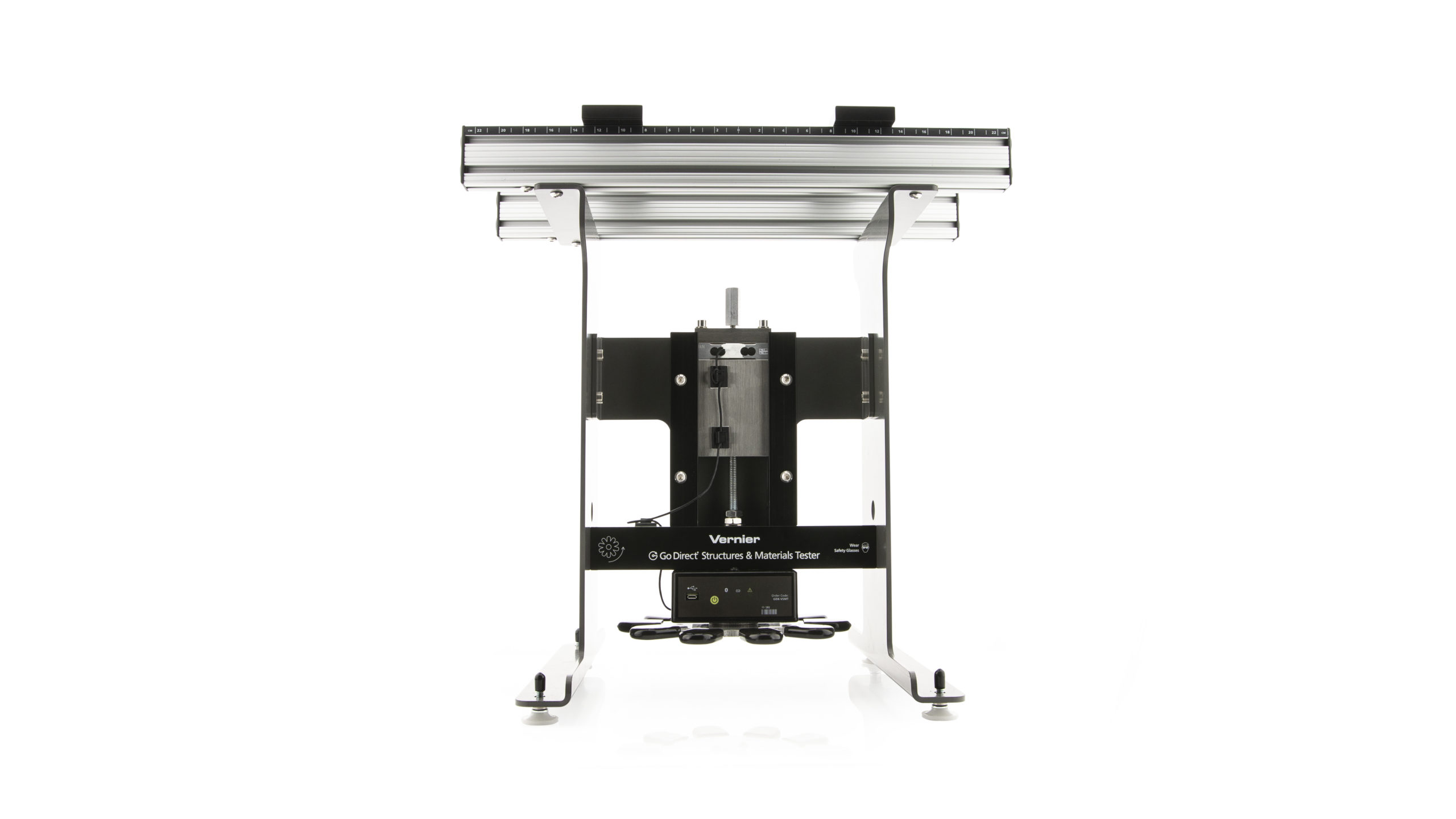
Go Direct® Structures & Materials Tester
University-grade educational structural testing equipment. Simultaneously measures applied force and deflection of structures and materials in real time. The free Graphical Analysis™ software displays the live force-displacement curve during testing.
Includes: Materials Testing: Beams to Bridges e-book (NGSS) · Tackle Kit (plates, chain, threaded rods, U-bolts) · micro USB cable · Bridge Competition Software (free download)
The webinar: Tom Smith (Vernier) demonstrates the GDX-VSMT live
In this Vernier webinar, engineering specialist Tom Smith shows how to use the Go Direct® Structures & Materials Tester to bring a bridge competition to the classroom — from preliminary beam and truss investigations to the final bridge load test, with real-time data:
The competition landscape: IIT, Science Olympiad, and more
Bridge competitions have a long institutional history. The best known internationally is the Illinois Institute of Technology International Bridge Competition. Its rules — updated annually — are an excellent starting point. The competition uses efficiency as the main metric: the ratio of supported load to bridge weight.
Science Olympiad also includes structural engineering events. The free Go Direct® Bridge Competition software manages these events: it classifies bridges by weight category, calculates efficiency in real time, and generates a live ranking during the event.
The International Bridge Building Competition sets a base rule of a 30 cm span — a useful reference for calibrating pre-competition tests on the GDX-VSMT, whose clear span reaches 45 cm.
Building tips that make the difference
These are the practical learnings Tom Smith shares with teachers, accumulated over years of competition programs:
- Build flat: assemble each bridge side directly on the 1:1 plan, using pins to hold position while glue dries. This ensures symmetry and geometric precision.
- Column joint vs. butt joint: whenever possible, align elements in column (force in direct line from piece to piece). When not possible, use butt joints — and maximize glue contact surface.
- Gussets: small reinforcing pieces over joints significantly increase strength. Real steel bridges use them universally.
- Rigorous symmetry: a bridge that is not symmetric distributes load asymmetrically and fails earlier. Verifying the level of both sides before joining them is critical.
- Cross-section optimization: instead of doubling beam height (stiffness ×8 but more weight), laminating half a height extra gives 3–4× the stiffness with much less weight — maximizing efficiency.
- Progressive stress testing: before the competition, apply incremental load with the GDX-VSMT to identify the deflection onset point. No need to take the bridge to complete failure.
Districalc can help you organize a bridge competition in your country
Districalc, a distributor of educational technologies present in over 20 Latin American countries since 1981, is Vernier's regional partner for structural engineering programs and bridge competitions. If your institution wants to organize a competition, we can support the entire process.
We supply the complete equipment: the GDX-VSMT, the VSMT-TRUSS accessory, the Materials Testing: Beams to Bridges e-book, and the free Go Direct® Bridge Competition software. We also offer in-person and remote teacher training.
Whether you want to organize an internal, inter-school, or regional competition, the GDX-VSMT is the platform that makes it possible to compare results objectively — with real data, not estimates.
If your institution is interested in organizing a bridge building competition — or simply in adding the GDX-VSMT to your engineering labs — contact us. Districalc works with institutions in over 20 Latin American countries.
Ready to organize a bridge competition at your institution?
Districalc provides the GDX-VSMT, teacher training, and pedagogical support to make your bridge competition a success — in any country in Latin America.
Contact UsFrequently asked questions
What is the minimum age to participate in a bridge competition?
Bridge competitions work well from high school onwards (ages 14-15+). The International Bridge Competition features winners at this level, though universities also participate. The materials strength and truss geometry content aligns best with technical or higher engineering curricula.
How many class sessions or hours are needed for a full bridge competition?
The article describes a full PDCA cycle (Plan, Do, Check, Act) that typically takes several weeks. Preliminary beam and truss investigations take "just a few classes" before design. Construction, iterative testing, and redesign with the GDX-VSMT require minimum 4-6 weeks of intensive work. Science Olympiad competitions use similar formats in single-day events.
What team size is ideal for a bridge competition?
The article does not specify a mandatory team size, but mentions that best results require division of responsibilities: design, construction, data testing. Teams of 4-6 students typically work well — enough for specialization without fragmenting critical design decisions. Competitions like Science Olympiad allow 2-3 person teams for single-day events.
Can a bridge competition be run on a limited budget?
Yes, construction materials are inexpensive: balsa wood, glue, and pins are cheap. The main cost is measurement equipment — the GDX-VSMT (1,000 N maximum, 0–7 cm range) is a lab investment used for many investigations, not just bridges. A school can share equipment across multiple annual competitions or student sections to amortize the cost.
How is a bridge competition evaluated and scored?
The main metric is efficiency: supported load divided by bridge weight (specified in IIT rules). The Go Direct® Bridge Competition software, mentioned in the article, automatically classifies bridges by weight category and calculates efficiency in real time, generating a ranking during the event. It is not subjective — there is an exact number of Newtons at failure measured by the GDX-VSMT.