What happens when programming stops being something abstract on a screen and becomes the code that makes a drone take off, clear an obstacle course, or complete a mission with no human intervention? That's exactly what the Aerial Drone Competition puts to the test, pitting high school, technical institute and university teams against each other in three formats: pilot (real-time manual control through circuits), team (collaborative challenges where coordination counts as much as flying skill), and autonomous (the drone completes its mission running entirely on Python or Scratch code).
The CoDrone EDU, the competition's core platform, packs gyroscope, accelerometer, barometer, optical flow and infrared sensors, so flight physics, systems engineering and programming stop being theory and become the code that gets a real aircraft airborne. The global edition lands in Chile on November 4, 2026, and keeps growing every year under the same premise: drones are the 21st-century lab.
Three categories, one mission: putting the full range of talent to the test
What sets the Aerial Drone Competition apart from other STEM initiatives is its three-category structure, each designed to evaluate a different aspect of the robotics and programming student's profile. A high-performing team does not just need good pilots — it needs good programmers, good strategists, and good communication.
Pilot Competition
Manual drone control with precision, speed, and skill. Pilots must navigate circuits, complete specific maneuvers, and demonstrate mastery of real-time flight control.
Team Competition
Collaborative challenges where success depends on the coordination of the entire team. Combines flight, strategy, and teamwork to complete missions no single pilot could achieve alone.
Autonomous Competition
The ultimate programming challenge: the drone must complete its mission with no human control in real time. Students program the entire flight sequence in Python or Scratch — the code is the only pilot.
The autonomous category is the one that demands the most computational thinking. Students must anticipate every variable — the position of obstacles, sensor tolerances, the sequence of maneuvers — and translate it into precise code instructions.
The autonomous competition forces students to think like systems engineers: it is not enough to know how to program — you must understand the drone's sensors, the hardware's error margins, and how code interacts with the physical world.
CoDrone EDU: the educational drone built to compete and learn
The central vehicle of the competition is the CoDrone EDU by Robolink — one of the most robust and versatile educational drones on the market. It was designed specifically for the classroom and competition, with a sensor suite that enables both precise manual flight and advanced autonomous programming.
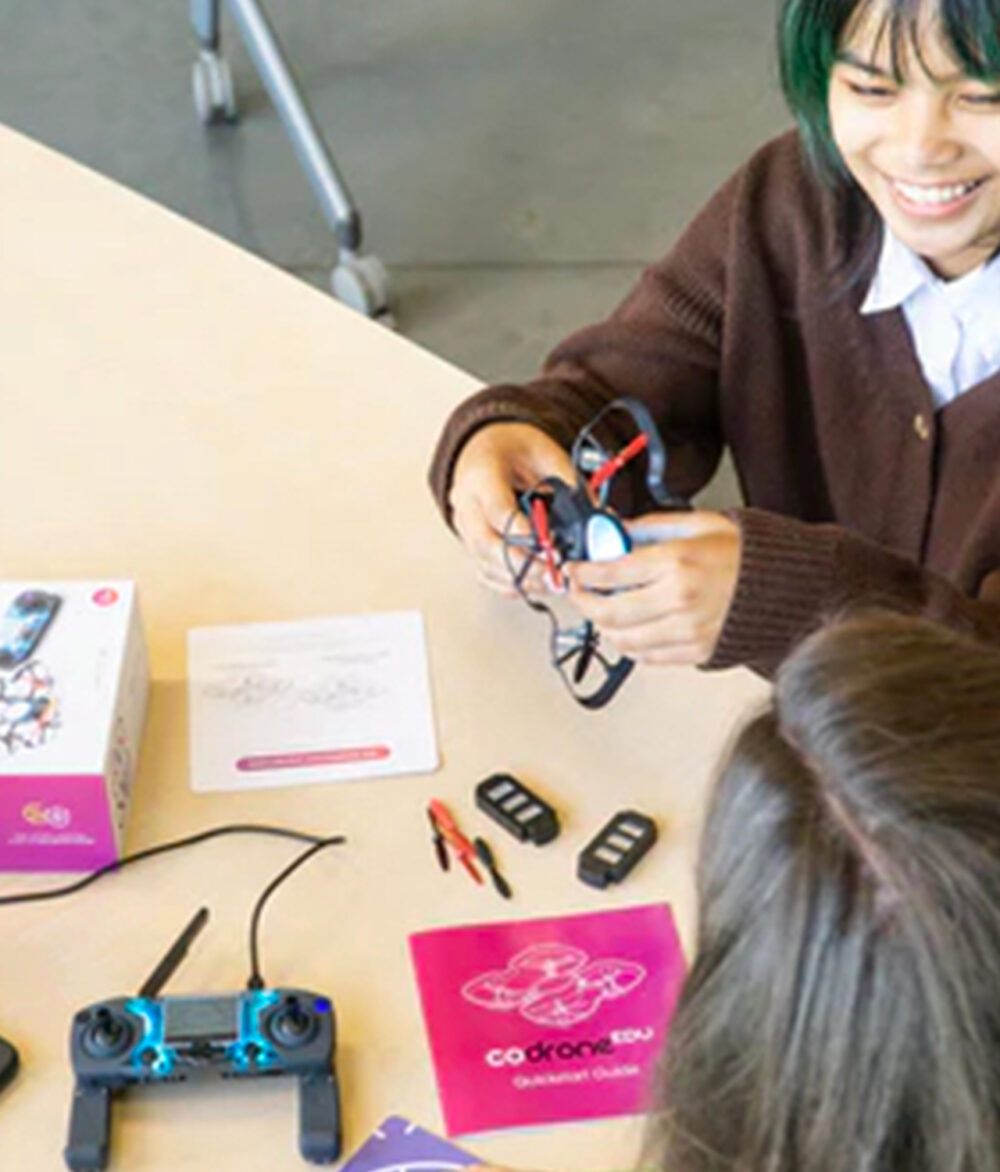
CoDrone EDU Sensors
What makes the CoDrone EDU suitable for autonomous competition is its integrated sensor set. Each sensor plays a specific role in flight and can be read and controlled directly from the student's code:
This sensor suite does not just ensure stable flight — it is a physics and programming curriculum embedded in the hardware. When programming the CoDrone EDU, students work directly with concepts of flight dynamics, control systems, sensor feedback, and conditional logic.
The CoDrone EDU is programmed in Python or Scratch, making it accessible from high school through university. Beginners start with visual blocks in Scratch; advanced teams harness the power of Python to develop sophisticated autonomous flight algorithms.
The competition in action
The following video shows the dynamics of the international aerial drone competition: teams in action, flight categories, the energy of the event, and the technical level reached by high school, technical, and university students:
Who participates? All levels, one shared challenge
One of the most powerful features of the competition is that it is designed to be inclusive across educational levels. Teams compete in categories matched to their stage of training.
- Secondary and technical education: students from technical high schools, institutes, and technology-focused schools. For many, the competition is the first time they turn code into real physical movement.
- Higher education: university teams who can take autonomous programming to greater levels of sophistication, integrating navigation algorithms and more complex control systems.
- Team format: the competition is always team-based, developing communication, role division, pressure management, and collective decision-making.
For teachers and technical program coordinators, the competition is a powerful pedagogical tool: it sets a concrete and exciting goal at the end of a learning process.
The skills the competition develops
The aerial drone competition is a multidisciplinary learning vector. Throughout the preparation and participation process, students develop competencies in areas far beyond robotics:
- Python and Scratch programming: from basic motor control to autonomous flight algorithms with conditional logic, loops, and real-time sensor data handling.
- Applied physics: flight dynamics, aerodynamic forces, atmospheric pressure, and stabilization systems — concepts students grasp better when they see them working in a drone they are programming.
- Systems engineering: hardware (sensors) and software (code) integration, uncertainty management, and designing robust strategies under variable conditions.
- Teamwork under pressure: clear roles, real-time communication, and collective decision-making when something does not work as programmed.
- Critical thinking and problem-solving: when the drone does not behave as the code predicts, teams diagnose whether the problem is logic, sensor calibration, or environmental conditions.
Technology and aerospace employers look for exactly these skills: programmers who understand hardware, engineers who can work as a team, and problem-solvers who do not freeze when something fails.
The Aerial Drone Competition comes to Chile on November 4, 2026 — and Districalc is the organizer
Districalc, a distributor of educational technologies present in over 20 Latin American countries since 1981, officially brings the Aerial Drone Competition to Chile on Wednesday, November 4, 2026, at the Centro Espacial de Chile. As local organizer, Districalc will lead team registration, teacher training, equipment supply, and event logistics.
Chile has a growing community of educators passionate about robotics and programming, and a network of technical high schools and higher education institutions already working with STEM platforms. The arrival of this competition gives that community a concrete, global, and motivating goal for their robotics programs.
Institutions interested in participating — as competing teams, regional co-organizers, or event sponsors — can contact Districalc directly. Only a few spots are available for this inaugural competition, and the preparation process requires advance time for CoDrone EDU programming training and strategy development.
If your institution wants to be part of this first Chilean edition of the Aerial Drone Competition — Wednesday, November 4, 2026, at the Centro Espacial de Chile — contact us now. Only a few spots are available. Districalc provides the equipment, training, and technical support so your team arrives prepared on competition day.
Does your institution want to compete on November 4, 2026?
The Aerial Drone Competition comes to Chile on Wednesday, November 4, 2026, at the Centro Espacial de Chile, organized by Districalc. Only a few spots remain for this inaugural competition — contact us to register your team, learn about equipment requirements, and receive training information.
Contact UsFrequently asked questions
What educational levels can participate in the Aerial Drone Competition?
The competition is designed for three levels: secondary education (technical high schools and institutes), specialized technical institutes, and universities. Teams compete in categories matched to their education stage, allowing each level to face appropriate challenges and avoiding unequal competition between different training stages.
What are the three categories of the drone competition?
The three categories are: Pilot (manual drone control with precision and real-time skill), Team (collaborative challenges requiring full team coordination), and Autonomous (the drone completes the mission without human control, entirely programmed in Python or Scratch). Each category evaluates different STEM skills from the student profile.
How much preparation time does a team need before competing?
The article indicates that the preparation process requires advance time, especially for CoDrone EDU programming training and competition strategy development. Only a few spots remain for the November 2026 competition in Chile, so early registration is recommended to allow adequate training time.
What programming languages does the CoDrone EDU use?
The CoDrone EDU is programmed in Python or Scratch. Beginners start with visual blocks in Scratch, making it accessible from high school onward. Advanced teams can harness Python's power to develop more sophisticated autonomous flight algorithms. This flexibility allows students at different levels to participate.
What are the key skills students develop in this competition?
Students develop Python and Scratch programming, applied physics (flight dynamics, aerodynamic forces), systems engineering (hardware-software integration), teamwork under pressure with real-time communication, and critical thinking to diagnose problems when code doesn't work as predicted. These are exactly the skills technology and aerospace employers seek.